Workplace Safety and Health (Major Hazard Installations) Regulations 2017

Source: Singapore Statutes Online | Archived by Legal Wires


No. S 202
Workplace Safety and Health Act
(CHAPTER 354A)
Workplace Safety and Health
(Major Hazard Installations)
Regulations 2017
In exercise of the powers conferred by section 65 of the Workplace Safety and Health Act, the Minister for Manpower makes the following Regulations:
PART 1
PRELIMINARY
Citation and commencement
1.  These Regulations are the Workplace Safety and Health (Major Hazard Installations) Regulations 2017 and come into operation on 1 September 2017.
Definitions
2.—(1)  In these Regulations, unless the context otherwise requires —
“dangerous substance” means a substance, mixture or preparation —
(a)specified in the first column of Part 1 of the First Schedule; or
(b)within a category specified in the first column of Part 2 of the First Schedule,
that is present or likely to be present as a raw material, a product, a by‑product, an intermediate or an intermediate product;
“deemed major hazard installation” means any factory not falling within the description in the Second Schedule but directed by the Commissioner under regulation 11(1) to be registered as a major hazard installation;
“emergency response plan” means —
(a)an emergency response plan mentioned in regulation 27 of the Fire Safety (Petroleum and Flammable Materials) Regulations (Cap. 109A, Rg 7); or
(b)an emergency action plan mentioned in regulation 22 of the Environmental Protection and Management (Hazardous Substances) Regulations (Cap. 94A, Rg 4);
“major accident” means an occurrence that —
(a)arises from one or more uncontrolled events, including a major emission, fire or explosion;
(b)involves one or more dangerous substances in the course of any operation or work being carried out within a major hazard installation; and
(c)results in death, serious harm or a substantial number of persons requiring medical attention, whether or not within the major hazard installation;
“major accident hazard” means anything with the potential to cause a major accident;
“major accident prevention policy” means a document setting out the policy with respect to the prevention of major accidents mentioned in paragraph 1 of Part 2 of the Third Schedule;
“major hazard installation” means any premises described in the Second Schedule;
“near miss” means an unplanned incident that had the potential to result in a process‑related incident, but did not result in a process‑related incident;
“process-related incident” means an incident that occurs in connection with an activity involving one or more dangerous substances, including their use, storage, manufacturing, handling, on‑site movement or distribution, or a combination of these activities, resulting in —
(a)an unintended explosion or fire causing damage to property, death or bodily injury to a person; or
(b)an unplanned or uncontrolled discharge of one or more dangerous substances,
and includes a major accident;
“registered major hazard installation” means any premises registered as a major hazard installation under regulation 9(1)(a);
“safety and health management system” means a safety and health management system mentioned in Part III of the Workplace Safety and Health (Safety and Health Management System and Auditing) Regulations 2009 (G.N. No. S 607/2009);
“safety case” means a document for the purposes specified in Part 1 of the Third Schedule and that complies with the requirements specified in Part 2 of that Schedule;
“serious harm” means any injury sustained by a person that —
(a)is life threatening;
(b)results in detriment to the person’s health over the long term; or
(c)results in permanent disability.
(2)  For the purposes of these Regulations, any change mentioned in regulation 17(3)(c) or any modification mentioned in regulation 18(2) is deemed to have a significant impact on the prevention of a major accident or the limitation of consequences of a major accident if the change or modification —
(a)introduces a new major accident hazard;
(b)changes a consequence of an existing major accident hazard;
(c)affects a control or mitigation measure put in place to ensure that the risk of a major accident remains as low as is reasonably practicable; or
(d)has an implication for the initiation or escalation of another major accident.
(3)  For the purposes of regulations 17(1) and 18(4), it is necessary to revise the safety case whenever the safety case must be updated for the purposes specified in Part 1 of the Third Schedule or to comply with the requirements specified in Part 2 of that Schedule.
PART 2
KEEPING, MAINTENANCE AND IMPLEMENTATION
OF SAFETY CASE
Application of this Part
3.  This Part applies to every major hazard installation or deemed major hazard installation, whether or not registered.
Duty to reduce risk of major accidents
4.  The occupier of a major hazard installation or deemed major hazard installation must take all measures necessary to reduce the risk of major accidents to as low as is reasonably practicable and to limit the consequences of major accidents.
Keeping and maintenance of safety case
5.  Subject to regulation 11(4), the occupier of a major hazard installation or deemed major hazard installation must keep and maintain a safety case in respect of the major hazard installation or deemed major hazard installation.
Implementation of safety case
6.  Subject to regulation 11(4), the occupier of a major hazard installation or deemed major hazard installation must implement the safety case for the major hazard installation or deemed major hazard installation by doing all of the following:
(a)implement the major accident prevention policy for the major hazard installation or deemed major hazard installation;
(b)ensure that the person mentioned in paragraph 1(b) of Part 2 of the Third Schedule carries out the roles and responsibilities specified in that paragraph;
(c)implement the plan mentioned in paragraph 1(d) of Part 2 of the Third Schedule;
(d)implement the safety and health management system in accordance with the Workplace Safety and Health (Safety and Health Management System and Auditing) Regulations 2009 (G.N. No. S 607/2009);
(e)ensure that the necessary resources, mentioned in paragraph 3 of Part 2 of the Third Schedule, are available for implementing the major accident prevention policy;
(f)implement the preventive measures mentioned in paragraph 5(a) of Part 2 of the Third Schedule;
(g)ensure that the processes carried out in the major hazard installation or deemed major hazard installation are carried out in accordance with the description in paragraph 5(b) of Part 2 of the Third Schedule;
(h)operate the major hazard installation or deemed major hazard installation in accordance with the description mentioned in paragraph 6(f) of Part 2 of the Third Schedule;
(i)implement the measures mentioned in paragraph 7 of Part 2 of the Third Schedule.
PART 3
REGISTRATION OF PREMISES AS MAJOR
HAZARD INSTALLATION
Register
7.—(1)  The Commissioner must cause a register of major hazard installations to be kept and maintained in such form as the Commissioner may determine.
(2)  The register must contain the building names (if any) and addresses of all registered major hazard installations and such other particulars of the major hazard installations as the Commissioner may determine.
Application to register major hazard installation
8.—(1)  An application to register any premises described in the Second Schedule as a major hazard installation must be made to the Commissioner.
(2)  An application under paragraph (1) must —
(a)be in the form and manner that the Commissioner requires for the application;
(b)be accompanied by such other particulars, information, statements and documents as the Commissioner may require; and
(c)be made at least 6 months before the premises are occupied or used as a major hazard installation or by such other date as the Commissioner may allow in any particular case.
Registration of major hazard installation
9.—(1)  After considering an application for registration, the Commissioner may —
(a)on payment of the appropriate registration fee specified in the Fourth Schedule —
(i)register the premises as a major hazard installation subject to such conditions as the Commissioner thinks fit to impose;
(ii)enter in the register of registered major hazard installations such particulars pertaining to the occupier of the premises and the major hazard installation as the Commissioner thinks fit; and
(iii)issue to the applicant a certificate of registration; or
(b)refuse to register the premises.
(2)  Where the Commissioner refuses to register the premises in respect of which an application for registration has been made, the Commissioner must notify the applicant of the reasons for the Commissioner’s refusal.
Duration of registration and renewal
10.—(1)  Subject to regulation 15(4), the registration of a registered major hazard installation is valid for a period of 5 years, or for such other period as the Commissioner may determine in a particular case, unless the registration is earlier revoked, suspended or cancelled in accordance with these Regulations.
(2)  The Commissioner may, on the application by the occupier of a registered major hazard installation to renew the registration —
(a)renew the registration on payment of the appropriate renewal fee specified in the Fourth Schedule; or
(b)refuse to renew the registration.
(3)  An application to renew the registration must be made not later than 6 months before the date of expiry of the registration, unless otherwise allowed by the Commissioner in any particular case.
(4)  An application to renew a registration must be accompanied by the particulars, information, statements and documents that the Commissioner requires for the application.
(5)  A registration may be renewed under paragraph (2)(a) for 5 years or such other period as the Commissioner may determine in a particular case, unless the registration is earlier revoked, suspended or cancelled in accordance with these Regulations.
Power to require registration in certain circumstances
11.—(1)  Subject to paragraph (2), where the Commissioner is satisfied that any factory not falling within the description of a major hazard installation in the Second Schedule is operating in such a manner as to pose, or is likely to pose, a significant risk to the safety, health and welfare of persons at work within or around the premises, the Commissioner may issue a direction to the occupier of the factory —
(a)specifying a date by which the factory must be registered as a major hazard installation; and
(b)specifying the period mentioned in paragraph (4).
(2)  The Commissioner may issue a direction under paragraph (1) only if the Commissioner has given the occupier of the factory concerned an opportunity to show cause as to why the factory should not be required to be registered as a major hazard installation.
(3)  Regulations 8(2), 9 and 10 apply to an application to register any factory as a major hazard installation in compliance with the Commissioner’s direction under paragraph (1).
(4)  Subject to paragraph (5), regulations 5 and 6 do not apply to a deemed major hazard installation for the period that the Commissioner may determine.
(5)  The occupier of a deemed major hazard installation must, by the end of the period mentioned in paragraph (4), submit to the Commissioner the safety case for the deemed major hazard installation.
Change in relation to occupation, use or particulars of registered major hazard installation
12.—(1)  The occupier of a registered major hazard installation must —
(a)where there is a change in any of the particulars of the registered major hazard installation entered in the register of major hazard installations, furnish particulars of the change to the Commissioner in the form and manner that the Commissioner requires, not later than 14 days after the change occurs; or
(b)where a change is to be made to the type of work carried out in the registered major hazard installation, inform the Commissioner of the proposed change and provide the Commissioner with the relevant documents pertaining to the change and such other information as the Commissioner may require, not less than one month before the change is to be made.
(2)  [Deleted by S 434/2024 wef 01/06/2024]
(3)  [Deleted by S 434/2024 wef 01/06/2024]
Duty to notify of stoppage, etc.
13.—(1)  The occupier of a registered major hazard installation must notify the Commissioner, in the form and manner that the Commissioner requires, if —
(a)the occupier intends to permanently decrease the quantity of a dangerous substance present or likely to be present in the premises of the registered major hazard installation such that the premises no longer fall within the description of a major hazard installation in the Second Schedule, not less than 14 days before decreasing the quantity of the dangerous substance; or
(b)the occupier intends to cease occupation or use of the premises as a major hazard installation, not less than 14 days before ceasing to occupy or use the premises.
(2)  [Deleted by S 434/2024 wef 01/06/2024]
Revocation, suspension or cancellation of registration
14.—(1)  The Commissioner may direct the occupier of a registered major hazard installation to comply with the requirements that the Commissioner specifies in the direction, if the premises of the registered major hazard installation become unfit for occupation or use as a major hazard installation because of —
(a)a failure by the occupier of the registered major hazard installation to ensure that the works carried out in the registered major hazard installation are carried out safely;
(b)a structural change to the premises of the registered major hazard installation or any change in the layout of the premises; or
(c)a fact or circumstance not present when the major hazard installation was registered.
(2)  The Commissioner may revoke the registration of a registered major hazard installation if —
(a)the occupier of the registered major hazard installation to whom a direction under paragraph (1) is given fails to comply with the direction;
(b)the Commissioner is satisfied that the occupier of the registered major hazard installation has contravened a condition of registration; or
(c)the Commissioner is satisfied that the occupier of the registered major hazard installation has ceased occupation or use of the premises as a major hazard installation.
(3)  However, the Commissioner may, in lieu of revoking the registration of a registered major hazard installation under paragraph (2), suspend the registration for such period as the Commissioner thinks fit.
(4)  The Commissioner may cancel the registration of a registered major hazard installation on the application of the occupier of the registered major hazard installation.
(5)  The Commissioner must, before revoking or suspending the registration of the registered major hazard installation under paragraph (2) or (3), give to the occupier of the registered major hazard installation —
(a)notice of the Commissioner’s intention to revoke or suspend the registration; and
(b)a reasonable opportunity to submit reasons as to why the registration should not be revoked or suspended.
(6)  Where the Commissioner has decided, under this regulation, to revoke or suspend the registration of the registered major hazard installation, the Commissioner must give notice of the decision to the occupier of that registered major hazard installation.
(7)  The revocation or suspension of the registration of a registered major hazard installation under paragraph (2) or (3) does not take effect —
(a)until the expiration of 21 days after the date on which notice of the Commissioner’s decision to revoke or suspend the registration was given to the occupier of the registered major hazard installation under paragraph (6); or
(b)where an appeal against the decision is made to the Minister under regulation 15, until the appeal has been determined or withdrawn.
(8)  The Commissioner may, at any time, and for any reason that the Commissioner considers sufficient, shorten the period for which the registration of a registered major hazard installation is suspended.
Appeals to Minister
15.—(1)  An applicant who is aggrieved by the Commissioner’s refusal —
(a)to register any premises as a major hazard installation; or
(b)to renew the registration of any premises as a major hazard installation,
may, within 21 days after the date the applicant is notified of the decision, appeal to the Minister in the form and manner that the Minister requires for the appeal.
(2)  The occupier of a registered major hazard installation who is aggrieved by the Commissioner’s decision to revoke or suspend the registration of the registered major hazard installation under regulation 14(2) or (3) may, within 21 days after the date the occupier is notified of the revocation or suspension, appeal to the Minister in the form and manner that the Minister requires for the appeal.
(3)  The occupier of any premises who is aggrieved by any direction of the Commissioner under regulation 11(1) or 14(1) may, within 7 days after the date the occupier is notified of the direction, appeal to the Minister in the form and manner that the Minister requires for the appeal.
(4)  Where an appeal is made under paragraph (1)(b), the registration of the major hazard installation concerned may continue to remain in force until the appeal has been determined or withdrawn, as the case may be.
(5)  Where an appeal is made under paragraph (3), the direction appealed against does not take effect until the appeal has been determined or withdrawn, as the case may be.
(6)  The Minister may determine an appeal under this regulation —
(a)by confirming the refusal, decision or direction of the Commissioner; or
(b)by substituting that refusal, decision or direction with the Minister’s decision in the appeal.
(7)  The decision of the Minister in an appeal under this regulation is final.
Waiver or refund of fees
16.  The Commissioner may waive or refund the whole or any part of any fee paid or payable under these Regulations.
PART 4
DUTIES OF OCCUPIER OF REGISTERED
MAJOR HAZARD INSTALLATION
Division 1 — Safety case
Review, revision and submission of safety case
17.—(1)  The occupier of a registered major hazard installation must review, and if necessary revise, the safety case for the registered major hazard installation at least once every 5 years.
(2)  The Commissioner may at any time direct the occupier of a registered major hazard installation to do all or any of the following within the period that the Commissioner specifies in the direction:
(a)submit to the Commissioner the safety case for the major hazard installation;
(b)revise the safety case;
(c)review the safety case.
(2A)  An occupier directed by the Commissioner under paragraph (2) must comply with the direction.
[S 434/2024 wef 01/06/2024]
(3)  Despite paragraphs (1), (2) and (2A), the occupier of a registered major hazard installation must review the safety case whenever —
(a)there is a new fact or new technical knowledge about safety and health matters in relation to the cause, prevention or effect of a major accident, including knowledge arising from —
(i)an analysis of a process‑related incident or near miss within the registered major hazard installation; or
(ii)a publication of an analysis of a process-related incident or near miss (whether or not within the registered major hazard installation);
(b)there is a discovery or development in knowledge in relation to any major accident hazard that is within the registered major hazard installation; or
(c)the occupier makes a change to the safety and health management system that has a significant impact on the prevention of a major accident or the limitation of consequences of a major accident.
[S 434/2024 wef 01/06/2024]
(4)  Where a safety case is reviewed under paragraph (1), (2) or (3), the occupier of the registered major hazard installation must —
(a)notify the Commissioner, in the form and manner that the Commissioner requires, of the date the review of the safety case was completed;
(b)submit to the Commissioner, in the form and manner that the Commissioner requires, a summary of the outcome of the review and of any changes made to the safety case; and
(c)if required by the Commissioner, submit a copy of the revised safety case to the Commissioner.
Modification of registered major hazard installation
18.—(1)  The occupier of a registered major hazard installation who intends to make any of the modifications in paragraph (2) must, before making the modification, notify the Commissioner of the intended modification.
(2)  The modifications mentioned in paragraph (1) are modifications that may have a significant impact on the prevention of a major accident or the limitation of the consequences of a major accident and involve —
(a)modifying a part of the registered major hazard installation;
(b)modifying a process that involves one or more dangerous substances carried on within the registered major hazard installation; or
(c)modifying the physical form or quantity of a dangerous substance present or likely to be present within the registered major hazard installation.
(3)  A notification of the intended modification under paragraph (1) must —
(a)be in the form and manner that the Commissioner requires for the notification; and
(b)be accompanied by such other particulars, information, statements and other documents as the Commissioner may require.
(4)  Where an occupier of a registered major hazard installation makes a modification mentioned in paragraph (2), the occupier must not use or operate, or allow to be used or operated, the modified part of the registered major hazard installation, the modified process within the registered major hazard installation or the modified dangerous substance, as the case may be, unless the occupier reviews, and if necessary revises, the safety case for the registered major hazard installation.
Division 2 — Notification and reporting
Duty to notify and report incidents
19.—(1)  The occupier of a registered major hazard installation must notify the Commissioner of a process-related incident as soon as reasonably practicable.
(2)  The occupier of a registered major hazard installation must submit a report to the Commissioner no later than 10 days after the occurrence of a process-related incident.
(3)  [Deleted by S 434/2024 wef 01/06/2024]
Duty to keep records
20.—(1)  The occupier of a registered major hazard installation must keep a record of every notification or report made by the occupier under these Regulations.
(2)  The occupier of the registered major hazard installation must furnish the Commissioner with any extract of the records that the Commissioner requires from time to time.
(3)  [Deleted by S 434/2024 wef 01/06/2024]
Form and manner of notification and reporting
21.  A notification or report required under this Division must be made in the form and manner that the Commissioner requires.
Division 3 — Provision of information
Provision of information to occupiers of other registered major hazard installations
22.—(1)  The Commissioner may designate one or more registered major hazard installations located in a particular location as a group of registered major hazard installations (called in this regulation a designated group).
(2)  The Commissioner must notify the occupier of every registered major hazard installation in a designated group of the names of the occupiers, and addresses, of the other registered major hazard installations in that designated group.
(3)  The occupier of a registered major hazard installation in a designated group must provide the information specified in the Fifth Schedule to the occupier of every other registered major hazard installation in the designated group —
(a)upon designation in the designated group;
(b)when there is a change in that information; or
(c)when required by the Commissioner.
(4)  Where the occupier of a registered major hazard installation in a designated group makes a change under regulation 17(3)(c) or a modification under regulation 18(2), the occupier must review and, if necessary, revise the information mentioned in paragraph (3).
(5)  Where the information mentioned in paragraph (3) is revised, the occupier must provide the revised information to the occupier of every other registered major hazard installation in the designated group within 14 days after the revision.
(6)  The occupier of a registered major hazard installation in a designated group must —
(a)take account of the information provided in paragraph (3) in formulating or revising the major accident prevention policy, safety case and emergency response plan for that registered major hazard installation; and
(b)cooperate with the occupier of every other registered major hazard installation in the designated group to enable those occupiers to carry out their obligations under these Regulations.
Provision of information to occupiers of other workplaces
23.  The occupier of a registered major hazard installation in a particular location must, if required by the Commissioner, provide any information that the Commissioner requires to any occupier of a workplace in that location.
PART 5
MISCELLANEOUS
Offences
24.—(1)  A person who, without reasonable excuse, contravenes regulation 4 or 6 shall be guilty of an offence and shall be liable on conviction to a fine not exceeding $50,000 or to imprisonment for a term not exceeding 2 years or to both.
(2)  A person who, without reasonable excuse, contravenes regulation 5, 11(5), 17(1), (2A), (3) or (4), 18(1), (3) or (4), 22(3), (4), (5) or (6) or 23 shall be guilty of an offence and shall be liable on conviction —
(a)to a fine not exceeding $20,000 or to imprisonment for a term not exceeding 2 years or to both; or
(b)if the person is a repeat offender, to a fine not exceeding $50,000 or to imprisonment for a term not exceeding 2 years or to both.
(3)  A person who, without reasonable excuse, contravenes regulation 12(1)(a) or 13(1) shall be guilty of an offence and shall be liable on conviction to a fine not exceeding $2,000.
(4)  A person who, without reasonable excuse, contravenes regulation 12(1)(b) shall be guilty of an offence and shall be liable on conviction to a fine not exceeding $5,000.
(5)  A person who, without reasonable excuse, contravenes regulation 19(1) or (2) shall be guilty of an offence and shall be liable on conviction —
(a)to a fine not exceeding $10,000; or
(b)if the person is a repeat offender, to a fine not exceeding $20,000 or to imprisonment for a term not exceeding 6 months or to both.
(6)  A person who, without reasonable excuse, contravenes regulation 20(1) or (2) shall be guilty of an offence and shall be liable on conviction —
(a)to a fine not exceeding $5,000; or
(b)if the person is a repeat offender, to a fine not exceeding $10,000 or to imprisonment for a term not exceeding 6 months or to both.
(7)  In this regulation, “repeat offender”, in relation to an offence, means a person who —
(a)is convicted, or found guilty, of an offence specified in the first column of Part 1, 2 or 3 of the Sixth Schedule (called the current offence); and
(b)has been convicted, or found guilty, of an offence specified opposite the current offence in the second column of Part 1, 2 or 3 of that Schedule (as the case may be), on at least one other earlier occasion within the period of 5 years immediately before the date on which the person is convicted, or found guilty, of the current offence.
[S 434/2024 wef 01/06/2024]
Saving and transitional provisions
25.—(1)  Every certificate of registration that —
(a)is issued to a major hazard installation registered as a factory under the Workplace Safety and Health (Registration of Factories) Regulations 2008 (G.N. No. S 501/2008) before 1 September 2017; and
(b)is valid immediately before that date,
is deemed, on or after that date and for so long as that certificate of registration remains valid, to be a valid certificate of registration issued under regulation 9(1)(a)(iii), subject to such conditions as the Commissioner thinks fit; and every major hazard installation for which there is such a valid certificate of registration is deemed to be a registered major hazard installation under these Regulations.
(2)  Regulations 5, 6 and 17 do not apply to the occupier of a major hazard installation mentioned in paragraph (1) until the earliest of the following dates:
(a)the date of expiry of its certificate of registration mentioned in paragraph (1)(a);
(b)31 August 2022;
(c)such other date not later than 31 August 2022 that the Commissioner may specify for that major hazard installation.
FIRST SCHEDULE
Regulation 2(1) and Second and
Fifth Schedules
Dangerous substances
Part 1
NAME OF DANGEROUS SUBSTANCES
First column
Second column
Third column
Name of dangerous substances
CAS number1
Threshold quantity (tonnes)
1 “CAS number” means the Chemical Abstract System (CAS) Registry Number assigned to a substance by the American Chemical Society.
1.2,4-Toluene diisocyanate & 2,6-Toluene diisocyanate
584-84-9
91-08-7
100
2.Acetylene
74-86-2
50
3.Ammonium nitrate
6484-52-2
5,000
4.Anhydrous Ammonia
7664-41-7
50
5.Arsenic pentoxide, arsenic (V) acid and/or salts
1303-28-2
10
6.Arsenic trioxide, arsenious (III) acid and/or salts
1327-53-3
10
7.Arsine (arsenic trihydride)
7784-42-1
1
8.Boron trifluoride
7637-07-2
20
9.Carbonyl dichloride (phosgene)
75-44-5
0.75
10.Chlorine
7782-50-5
25
11.Ethylene oxide
75-21-8
25
12.Ethyleneimine
151-56-4
20
13.Formaldehyde (concentration >90%)
50-00-0
50
14.Hydrogen
1333-74-0
25
15.Hydrogen chloride (anhydrous and refrigerated liquid)
7647-01-0
150
16.Hydrogen fluoride (anhydrous)
7664-39-3
15
17.Hydrogen sulphide
7783-06-4
20
18.Liquefied flammable gases, Category 1 or 2 (including LPG)
200
19.Methanol
67-56-1
5,000
20.Methyl acrylate
96-33-3
2,000
21.Methylisocyanate
624-83-9
0.15
22.Oxygen
7782-44-7
2,000
23.Petroleum products and alternative fuels
14,000
(a)gasolines and naphthas
 
 
(b)kerosenes (including jet fuels)
 
 
(c)gas oils (including diesel fuels and gas oil blending streams)
 
 
(d)heavy fuel oils
 
 
(e)alternative fuels serving the same purposes and with similar properties, with regard to flammability, to the products mentioned in paragraphs (a) to (d)
 
 
24.Phosphine (phosphorus trihydride)
7803-51-2
1
25.Potassium nitrate
7757-79-1
5,000
26.Propylamine
107-10-8
2,000
27.Propylene oxide
75-56-9
25
28.Sulphur trioxide
7446-11-9
75
29.Tert-butyl acrylate
1663-39-4
500
Part 2
CATEGORY OF DANGEROUS SUBSTANCES
NOT SPECIFICALLY NAMED IN PART 1
First column
Second column
Categories of dangerous substances with reference to
Globally Harmonised System of Classification
Threshold quantity (tonnes)
Section ‘H’ – HEALTH HAZARDS
H1ACUTE TOXIC
15
Acute toxic, Category 1, any exposure routes
 
H2ACUTE TOXIC
200
Acute toxic, Category 2, any exposure routes
 
Acute toxic, Category 3, inhalation exposure route
 
H3SPECIFIC TARGET ORGAN TOXICITY (STOT) – SINGLE EXPOSURE
200
STOT SE, Category 1
 
Section ‘P’ – PHYSICAL HAZARDS
P1aEXPLOSIVES
50
Explosives, Unstable explosives or Division 1.1, 1.2, 1.3 or 1.5
 
P1bEXPLOSIVES
200
Explosives, Division 1.4, or 1.6
 
P2FLAMMABLE GASES
25
Flammable gases, Category 1 or 2
 
P3AEROSOLS
500
Aerosols, Category 1 or 2
 
P4OXIDISING GASES
200
Oxidising gases, Category 1
 
P5aFLAMMABLE LIQUIDS
40
Flammable liquids, Category 1
 
Flammable liquids, Category 2 or 3 maintained at a temperature above their boiling point
 
Other liquids with a flash point ≤60°C, maintained at a temperature above their boiling point
 
P5bFLAMMABLE LIQUIDS
150
Flammable liquids, Category 2 or 3 where particular processing conditions, such as high pressure or high temperature, may create major accident hazards
 
Other liquids with a flash point ≤60°C where particular processing conditions, such as high pressure or high temperature, may create major accident hazards
 
P5cFLAMMABLE LIQUIDS
28,000
Flammable liquids, Category 2 or 3 not covered by P5a and P5b
 
P5dFLAMMABLE SOLIDS
200
Flammable solids, Category 1 or 2
 
P6aSELF-REACTIVE SUBSTANCES AND MIXTURES and ORGANIC PEROXIDES
50
Self-reactive substances and mixtures, Type A or B
 
Organic peroxides, Type A or B
 
P6bSELF-REACTIVE SUBSTANCES AND MIXTURES and ORGANIC PEROXIDES
200
Self-reactive substances and mixtures, Type C, D, E or F
 
Organic peroxides, Type C, D, E, or F
 
P7PYROPHORIC LIQUIDS AND SOLIDS
200
Pyrophoric liquids, Category 1
 
Pyrophoric solids, Category 1
 
P8OXIDISING LIQUIDS AND SOLIDS
200
Oxidising liquids, Category 1, 2 or 3
 
Oxidising solids, Category 1, 2 or 3
 
Section ‘O’ – OTHER HAZARDS
O1Substances and mixtures which in contact with water emit flammable gases, Category 1
500
O2Desensitized explosives when dry are Explosives of Class 1 other than those of compatibility group A, which are wetted with sufficient water, alcohol, or plasticizer to suppress explosive properties
200
SECOND SCHEDULE
Regulations 2(1), 8(1), 11(1) and 13(1)(a)
Major hazard installation
  Any premises where processing, manufacturing or bulk storage by way of trade or for the purpose of gain is carried on of one or more dangerous substances specified in the First Schedule where —
(a)the quantity of a dangerous substance present or is likely to be present in the premises —
(i)being a dangerous substance specified in the first column of Part 1 of the First Schedule, is equal to or exceeds the corresponding threshold quantity in the third column; or
(ii)being a dangerous substance within a category specified in the first column of Part 2 of the First Schedule, is equal to or exceeds the corresponding threshold quantity in the second column; or
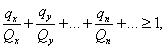
(b)the aggregate sum of ratios, of the dangerous substances specified in the First Schedule present or likely to be present in the premises, that is calculated using the following formula, is equal to or exceeds 1:
where —
(i)x, y, [....] and n are the dangerous substances present or likely to be present in the premises;
(ii)qx, qy, [....] and qn is the total quantity of the respective dangerous substances x, y, [....] and n present or likely to be present in the premises; and
(iii)Qx, Qy, [....] and Qn is the corresponding threshold quantity specified in the third column of Part 1 of the First Schedule or the second column of Part 2 of that Schedule, as the case may be, for each dangerous substance x, y, [....] and n.
THIRD SCHEDULE
Regulations 2(1) and (3) and 6
Safety case
Part 1
PURPOSES OF SAFETY CASE
1.To demonstrate that a major accident prevention policy and a safety and health management system have been established and implemented.
2.To demonstrate that all major accident hazards have been identified and that —
(a)the risk of occurrence of any major accident has been eliminated; or
(b)where it is not reasonably practicable to eliminate the risk of a major accident, the risk has been reduced to as low as is reasonably practicable to limit the consequences of an accident.
3.To demonstrate that adequate safety and reliability measures, for any installation, equipment or infrastructure connected with the operation of a major hazard installation, in relation to major accident hazards within the major hazard installation have been incorporated into —
(a)the major hazard installation’s design and construction; and
(b)the major hazard installation’s operation and maintenance.
4.To demonstrate that an emergency response plan has been drawn up to take the necessary measures in the event of a major accident.
Part 2
MINIMUM INFORMATION TO BE INCLUDED IN SAFETY CASE
1.A written major accident prevention policy that —
(a)sets out the occupier’s overall aims and principles of action;
(b)sets out the role and responsibility of the person or persons managing the operation of the major hazard installation;
(c)demonstrates the occupier’s commitment to continually improving the control of all major accident hazards, in accordance with any relevant guidelines that the Commissioner may issue; and
(d)sets out a plan that adequately addresses any major accident hazard, proportionately to the risk and consequences of the major accident hazard.
2.Every section of the safety and health management system in relation to major accident prevention.
3.The resources for implementing the major accident prevention policy, in accordance with the generally accepted principles of safe and sound practice.
4.A presentation of the vicinity of the major hazard installation which —
(a)describes the site and its vicinity including the geographical location and, if necessary, its history;
(b)identifies the installations and other activities of the major hazard installation that can present a major accident hazard;
(c)identifies the neighbouring workplaces, areas and developments that may be a source of or cause an increase in the risk or consequences of —
(i)a major accident in the major hazard installation; and
(ii)a major accident, in the major hazard installation or at the neighbouring workplace, area or development, that is initiated by the cumulative effects of an accident within the major hazard installation; and
(d)describes the areas where a major accident may occur.
5.A description of the major hazard installation including —
(a)a description of the main activities and products of the parts of the major hazard installation which are important from the point of view of safety, sources of major accident risks and conditions under which such a major accident could happen, together with a description of the preventive measures;
(b)a description of the processes, including the operating methods; and
(c)a description of the dangerous substances present or likely to be present, including the following details:
(i)the inventory of the dangerous substances including the identification of dangerous substances and the maximum quantity of dangerous substances present or likely to be present;
(ii)the physical, chemical, toxicological characteristics and indication of the hazards, both immediate and delayed for human health; and
(iii)the physical and chemical behaviour under normal conditions of use or, in the event of a foreseeable accident, under foreseeable conditions.
6.A description of the methods used in identification, risk assessment and risk control of major accident hazards, including —
(a)a detailed description of possible major accidents and their probability of occurrence or the conditions under which they may occur;
(b)a summary of the events which may play a role in triggering each of these possible major accidents;
(c)the potential causes (whether internal or external to the major hazard installation) of these possible major accidents including —
(i)potential operational causes;
(ii)potential external causes, such as an accident in the neighbouring area or developments that could be the source of, or increase the risk or consequences of a major accident; and
(iii)potential natural causes (if any);
(d)an assessment of the extent and severity of the consequences of possible major accidents by way of diagrammatic representation (including, but not limited to, maps or images) setting out the areas which may be affected by such accidents;
(e)a review of past accidents, process-related incidents and near misses that involved the same substances or processes, including the lessons learnt and the preventive measures implemented; and
(f)a description of technical parameters and equipment used to ensure safe operation of the major hazard installation.
7.The measures implemented to limit the consequences of an accident, including —
(a)a description of the equipment installed within the major hazard installation to limit the consequences of major accidents;
(b)a description of the status of organisation for the purposes of alert and intervention;
(c)a description of mobilisable resources, internal or external; and
(d)a description of any technical and non-technical measures relevant for the reduction of the impact of a major accident.
FOURTH SCHEDULE
Regulations 9(1)(a) and 10(2)(a)
Fees
  The fees for the issue and renewal of a certificate of registration are set out in the third and fourth columns, respectively, of the table below opposite the major hazard installation —
(a)that falls within the class of major hazard installation specified in the first column of the table below; and
(b)the aggregate sum of ratios of dangerous substances of which, fall within the range specified in the second column of the table below.
First column
Second column
Third column
Fourth column
Classes of major hazard installation
Range of aggregate sum of ratios of dangerous substances
Registration fee
Renewal fee
(a)Deemed major hazard installation
$4,550
$4,550
(b)Storage of one or more dangerous substances in warehouses
(i)50 or less
$4,550
$4,550
(ii)more than 50 but not more than 100
$8,300
$8,300
 
(iii)more than 100
$12,800
$12,800
(c)Bulk storage of one or more dangerous substances
(i)5 or less
$4,550
$4,550
(ii)more than 5 but not more than 100
$8,300
$8,300
 
(iii)more than 100
$12,800
$12,800
(d)Manufacturing and processing of one or more dangerous substances
(i)5 or less
$4,550
$4,550
(ii)more than 5 but not more than 50
$8,300
$8,300
 
(iii)more than 50
$12,800
$12,800
FIFTH SCHEDULE
Regulation 22(3)
Information to be supplied by occupier of
major hazard installation
1.Name of occupier and address of the major hazard installation.
2.Identification, by position held, of the person giving the information on behalf of the occupier.
3.An explanation in simple terms of the activity or activities undertaken within the major hazard installation.
4.The common names or, in the case of dangerous substances falling within Parts 1 and 2 of the First Schedule, the generic names or the hazard classification of the substances present or likely to be present within the major hazard installation which could give rise to a major accident, with an indication of their principal dangerous characteristics.
5.General information relating to the nature of the major accident hazards within the major hazard installation, including their potential effects on individuals and workplaces.
6.Information on how affected workplaces will be alerted in the event of a major accident within the major hazard installation.
7.Recommended actions that the affected workplaces can take in the event of a major accident within the major hazard installation.
SIXTH SCHEDULE
Regulation 24(7)
Current offence and
corresponding previous offence
Part 1
OFFENCE UNDER REGULATION 24(2)
First column
Current offence
Second column
Previous offence
1.Offence for contravening regulation 5
(a)the current offence in this item; or
(b)an offence under regulation 24(a) as in force immediately before 1 June 2024 for contravening regulation 5
2.Offence for contravening regulation 11(5)
(a)the current offence in this item; or
(b)an offence under regulation 24(a) as in force immediately before 1 June 2024 for contravening regulation 11(5)
3.Offence for contravening regulation 17(1)
(a)the current offence in this item; or
(b)an offence under regulation 24(a) as in force immediately before 1 June 2024 for contravening regulation 17(1)
4.Offence for contravening regulation 17(2A)
(a)the current offence in this item; or
(b)an offence under regulation 24(b) as in force immediately before 1 June 2024
5.Offence for contravening regulation 17(3)
(a)the current offence in this item; or
(b)an offence under regulation 24(a) as in force immediately before 1 June 2024 for contravening regulation 17(3)
6.Offence for contravening regulation 17(4)
(a)the current offence in this item; or
(b)an offence under regulation 24(a) as in force immediately before 1 June 2024 for contravening regulation 17(4)
7.Offence for contravening regulation 18(1)
(a)the current offence in this item; or
(b)an offence under regulation 24(a) as in force immediately before 1 June 2024 for contravening regulation 18(1)
8.Offence for contravening regulation 18(3)
(a)the current offence in this item; or
(b)an offence under regulation 24(a) as in force immediately before 1 June 2024 for contravening regulation 18(3)
9.Offence for contravening regulation 18(4)
(a)the current offence in this item; or
(b)an offence under regulation 24(a) as in force immediately before 1 June 2024 for contravening regulation 18(4)
10.Offence for contravening regulation 22(3)
(a)the current offence in this item; or
(b)an offence under regulation 24(a) as in force immediately before 1 June 2024 for contravening regulation 22(3)
11.Offence for contravening regulation 22(4)
(a)the current offence in this item; or
(b)an offence under regulation 24(a) as in force immediately before 1 June 2024 for contravening regulation 22(4)
12.Offence for contravening regulation 22(5)
(a)the current offence in this item; or
(b)an offence under regulation 24(a) as in force immediately before 1 June 2024 for contravening regulation 22(5)
13.Offence for contravening regulation 22(6)
(a)the current offence in this item; or
(b)an offence under regulation 24(a) as in force immediately before 1 June 2024 for contravening regulation 22(6)
14.Offence for contravening regulation 23
(a)the current offence in this item; or
(b)an offence under regulation 24(a) as in force immediately before 1 June 2024 for contravening regulation 23
Part 2
OFFENCE UNDER REGULATION 24(5)
First column
Current offence
Second column
Previous offence
1.Offence for contravening regulation 19(1)
(a)the current offence in this item; or
(b)an offence under regulation 19(3) as in force immediately before 1 June 2024 for contravening regulation 19(1)
2.Offence for contravening regulation 19(2)
(a)the current offence in this item; or
(b)an offence under regulation 19(3) as in force immediately before 1 June 2024 for contravening regulation 19(2)
Part 3
OFFENCE UNDER REGULATION 24(6)
First column
Current offence
Second column
Previous offence
1.Offence for contravening regulation 20(1)
(a)the current offence in this item; or
(b)an offence under regulation 20(3) as in force immediately before 1 June 2024 for contravening regulation 20(1)
2.Offence for contravening regulation 20(2)
(a)the current offence in this item; or
(b)an offence under regulation 20(3) as in force immediately before 1 June 2024 for contravening regulation 20(2)
[S 434/2024 wef 01/06/2024]
Made on 27 April 2017.
AUBECK KAM
Permanent Secretary,
Ministry of Manpower,
Singapore.
[C010-048-0020; AG/LEGIS/SL/354A/2015/3 Vol. 3]
(To be presented to Parliament under section 65(8) of the Workplace Safety and Health Act).

Archived for legal research. Authoritative version at sso.agc.gov.sg.