Radiation Protection (Non-Ionising Radiation) Regulations

Source: Singapore Statutes Online | Archived by Legal Wires


Radiation Protection Act
(CHAPTER 262, Section 28)
Radiation Protection
(Non-Ionising Radiation) Regulations
Rg 1
G.N. No. S 479/1991

REVISED EDITION 2001
(15th September 2001)
[1st February 1992]
 
ABBREVIATIONS EMPLOYED IN THESE REGULATIONS
ºC
 
:
 
degree Celsius
kg
 
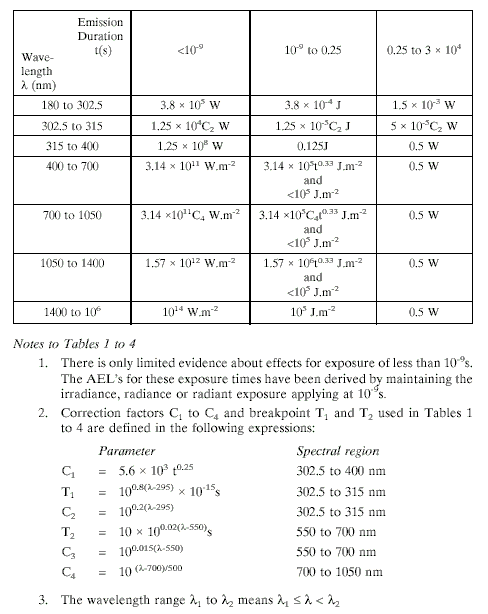
:
 
kilogram
dB
 
:
 
decibel
T
 
:
 
tesla
J
 
:
 
joule
µSv
 
:
 
microsievert
Bo
 
:
 
static magnetic field strength
dB/dt
 
:
 
rate of change of magnetic field strength with time
r.m.s. volts
 
:
 
root mean square volts
sr
 
:
 
steradian
m
 
:
 
metre
cm
 
:
 
centimetre
mm
 
:
 
millimetre
µm
 
:
 
micrometre
nm
 
:
 
nanometre
l
 
:
 
litre
ml
 
:
 
millilitre
s
 
:
 
second
µs
 
:
 
microsecond
Hz
 
:
 
hertz
kHz
 
:
 
kilohertz
MHz
 
:
 
megahertz
GHz
 
:
 
gigahertz
kW
 
:
 
kilowatt
W
 
:
 
watt
mW
 
:
 
milliwatt
µW
 
:
 
microwatt
[S 517/2019 wef 01/08/2019]
PART I
PRELIMINARY
Citation
1.  These Regulations may be cited as the Radiation Protection (Non-Ionising Radiation) Regulations.
Definitions
2.—(1)  In these Regulations, unless the context otherwise requires —
“accessible location” means any point that can be reached by any part of the human body;
“AEL” means accessible emission limits;
“ANSI Z136.1 – 2007” means the American National Standards Institute (ANSI) Z136.1 – 2007 American National Standard for Safe Use of Laser;
[S 517/2019 wef 01/08/2019]
“ANSI Z136.1 – 2014” means the American National Standards Institute (ANSI) Z136.1 – 2014 American National Standard for Safe Use of Laser;
[S 517/2019 wef 01/08/2019]
“applicator” means the part of the ultrasound device designed to transmit ultrasonic power from the transducer to the patient or materials, and includes the transducer and any associated housing;
“approved” means approved in writing by the Director‑General;
[S 517/2019 wef 01/08/2019]
“beam” means a collection of rays that may be parallel, convergent or divergent;
“cavity” means that portion of the microwave oven in which food or other materials may be heated, cooked or dried;
[Deleted by S 34/2022 wef 15/01/2022]
“collateral radiation” means any electronic product radiation, except laser radiation, emitted by a laser apparatus as a result of the operation of the laser or any component of the laser apparatus that is physically necessary for the operation of the laser;
“continuous wave”  —
(a)in relation to ultrasound, means a wave in which the ratio of the temporal maximum pressure amplitude to the root-mean-square pressure amplitude, each spatially averaged over the effective radiating surface, is less than or equal to 1.05; and
(b)in relation to a laser, means an emission of laser radiation for a period of 0.25 second or longer;
“deal” means any activity involving an irradiating apparatus other than use, possess for use and import or export;
“diameter” means the minimum diameter of a circular aperture that, when placed to intercept laser beam with the plane of the circular aperture perpendicular to the direction of propagation of the beam, will permit 86.5% of the total beam power to be transmitted;
“divergence” means the full angle of spread of a laser beam;
“door”, in relation to microwave oven, means a movable barrier which prevents access to the cavity of the microwave oven during operation and whose function is to prevent emission of microwave energy from the passage or opening which provides access to the cavity;
“exit aperture” means an opening or window in the protective enclosure of a laser system that is designed to allow laser radiation to be transmitted outside;
“exposure position”, in relation to ultraviolet sunlamp, means any location, orientation, place or distance relative to the ultraviolet radiating surfaces of the sunlamp at which it is recommended by the manufacturer that the user of the sunlamp be exposed;
“external surface”, in relation to microwave oven means the outside surface of the cabinet or enclosure provided by the manufacturer as part of the microwave oven, including any door, door handle, latch and control knob;
“eye examination” means the following examinations performed by a registered medical practitioner:
(a)visual acuity examination;
(b)manifest refraction examination;
(c)external ocular examination;
(d)examination by slit lamp;
(e)examination of the ocular fundus with an ophthalmoscope; and
(f)any other necessary examination;
[Deleted by S 34/2022 wef 15/01/2022]
“healthcare institution” means —
(a)any premises at which a licensee under the Healthcare Services Act 2020 is approved under section 11B of that Act to provide a licensable healthcare service; or
[S 807/2023 wef 18/12/2023]
(b)any conveyance that a licensee under the Healthcare Services Act 2020 is approved under section 11B of that Act to use to provide a licensable healthcare service;
[S 807/2023 wef 18/12/2023]
(c)[Deleted by S 807/2023 wef 18/12/2023]
[S 407/2023 wef 26/06/2023]
“IEC 60825-1:2007” means the International Electrotechnical Commission International Standard IEC 60825-1:2007 Safety of laser products — Part I: Equipment classification and requirements;
[S 517/2019 wef 01/08/2019]
“IEC 60825-1:2014” means the International Electrotechnical Commission International Standard IEC 60825-1:2014 Safety of laser products — Part I: Equipment classification and requirements;
[S 517/2019 wef 01/08/2019]
“individual” means any natural person;
“installation” means the area of radiation hazard under the administrative control of the person possessing the irradiating apparatus;
“integrated irradiance” means the radiant energy incident per unit area of surface expressed as J/m2;
“irradiance” means radiant power incident per unit area expressed as W/m2;
“irradiating apparatus” means any apparatus of a type specified in the First Schedule;
“laser” means any device that can be made to produce light primarily by the process of stimulated emission;
“laser radiation” means all electromagnetic radiation generated by a laser that is coherent and propagates collinearly through space;
“lasing medium” means a material that emits laser radiation by virtue of stimulated transitions between specific electronic or molecular energy levels;
“leakage radiation” means all radiation other than the useful beam;
“licensable healthcare service” has the meaning given by section 3(1) of the Healthcare Services Act 2020;
[S 807/2023 wef 18/12/2023]
“licensee” means a person who holds a licence under the Act;
[Deleted by S 34/2022 wef 15/01/2022]
“maximum exposure time”, in relation to the ultraviolet sunlamp, means the longest time interval for continuous exposure recommended by the manufacturer of a sunlamp;
“maximum timer interval”, in relation to ultraviolet sunlamp, means the longest time interval setting on the timer of a sunlamp;
[Deleted by S 34/2022 wef 15/01/2022]
“medical laser” means any laser product manufactured, designed, intended or promoted for purposes of in vivo diagnostic, surgical, cosmetic or therapeutic laser irradiation of any part of the human body;
[S 517/2019 wef 01/08/2019]
“minimum interval between consecutive exposures”, in relation to sunlamp, means the shortest time interval between 2 consecutive exposures recommended by the manufacturer of a sunlamp;
“N1 licence” means a licence to manufacture or deal with any of the irradiating apparatus specified in Parts I, II and III of the First Schedule;
[S 517/2019 wef 01/08/2019]
“N2 licence” means a licence to keep, or possess, for use any of the irradiating apparatus specified in Parts II and III of the First Schedule;
[S 517/2019 wef 01/08/2019]
“N3 licence” means a licence to use any of the irradiating apparatus specified in Part III of the First Schedule;
[S 517/2019 wef 01/08/2019]
“N4A licence” means a licence to import any of the irradiating apparatus specified in Parts I, II and III of the First Schedule;
[S 517/2019 wef 01/08/2019]
“N4B licence” means a licence to export any of the irradiating apparatus specified in Parts II and III of the First Schedule;
[S 517/2019 wef 01/08/2019]
“non-ionising radiation” means electromagnetic radiations and fields with wavelengths greater than 100 nm or acoustic radiations and fields with frequencies below 16 Hz and above 16 kHz;
[Deleted by S 34/2022 wef 15/01/2022]
“person”, includes any company or association or body of persons, corporate or unincorporate;
“primary radiation” means radiation coming directly from any irradiating apparatus;
[Deleted by S 34/2022 wef 15/01/2022]
“protective enclosure” means a structure that encloses a laser and its accessory components and restricts the emission of laser radiation to one or more than one exit aperture;
“protective eyewear” means any device designed to be worn by the user to reduce, directly or indirectly, the radiation reaching the eyes;
“protective housing” means a structure that encloses the components of a laser system and prevents the emission of laser radiation except through an exit aperture;
“pulse” means an intermittent emission of laser radiation for a duration of less than 0.25 second;
“pulse duration” means the time interval measured between the half-peak power points on the leading and trailing edges of a pulse;
“radiation” means non-ionising radiation for the purpose of these Regulations;
“radiation hazard” means the danger to the health of an individual arising from exposure to radiation emitted from an irradiating apparatus;
“radiation level” means the corresponding radiation power density expressed in W/m2;
“radiation work” means work which involves the use, handling or operation of any irradiating apparatus specified in Parts II and III of the First Schedule;
“radiation worker” means any individual who is engaged in or is employed for part or whole of his working time to do radiation work;
“registered dentist” means any person who is registered as a dentist under the Dental Registration Act (Cap. 76), and includes any person deemed to be a registered dentist under section 64(1) of that Act;
[S 517/2019 wef 01/08/2019]
“SAR” means specific absorbed rate;
“safety interlock”  —
(a)in relation to a microwave oven, means a device or system of devices which is intended to prevent generation of radiation when access to the cavity is possible;
(b)in relation to a laser, means a device associated with the protective housing of a laser apparatus to prevent human access to excessive laser radiation;
“scanned laser radiation” means laser radiation having a time varying direction, origin or pattern of propagation with respect to a stationary frame of reference;
“scattered radiation” means radiation which, during its passage through a substance, has been deviated in direction or has been modified by an increase in wave length;
“service” means any adjustment, procedure or servicing method prescribed by the manufacturer of an irradiating apparatus;
“service controls” means any control provided by the manufacturer for the purpose of adjustment of an irradiating apparatus and that, under normal conditions of use, is not accessible to the user of the apparatus;
“shutter” means a mechanism that, in its closed position, intercepts the radiation beam and prevents the emission of radiation from the irradiating apparatus;
“spectral irradiance” means the irradiance resulting from radiation within an infinitesimally small wavelength range expressed as W/m2/nm;
“spectral transmittance” means the spectral irradiance transmitted through protective eyewear divided by the spectral irradiance incident on the protective eyewear;
“timer” means any device that is incorporated into an irradiating apparatus and is capable of terminating the emission of radiation from the apparatus at the end of a preset time interval;
“user controls” means a control provided by the manufacturer for the purpose of operation of an irradiating apparatus that, under normal conditions of use, is accessible to the user of the apparatus.
[S 517/2019 wef 01/08/2019]
(2)  In these Regulations, unless the context otherwise requires, any reference to a numbered Class is a reference to a Class, bearing the corresponding number, of lasers classified in accordance with the classification set out in the Second Schedule, and includes a reference to an equivalent class of lasers classified in accordance with IEC 60825‑1:2007, IEC 60825-1:2014, ANSI Z136.1 – 2007 or ANSI Z136.1 – 2014.
[S 517/2019 wef 01/08/2019]
Laser classification standards
2A.  For the purposes of these Regulations —
(a)the laser classification standards specified in the Seventh Schedule take precedence in the order in which those standards appear in that Schedule; and
(b)where a laser has in fact been classified in accordance with 2 or more of those standards, the laser is to be treated as classified in accordance with the standard that takes precedence.
[S 517/2019 wef 01/08/2019]
PART II
CONTROLLED NON-IONISING RADIATION APPARATUS
Controlled apparatus
3.  The Act and these Regulations shall apply to the following irradiating apparatus:
(a)ultraviolet sunlamps;
(b)microwave ovens;
(c)medical and industrial ultrasound apparatus;
(d)magnetic resonance imaging (MRI) apparatus;
(e)entertainment lasers; and
(f)high power lasers.
PART III
LICENCES
Application for licences
4.—(1)  Every application for a licence or for renewal thereof shall be made to the Director‑General in such form as he may require.
[S 517/2019 wef 01/08/2019]
(2)  Every application to alter the list of irradiating apparatus in respect of which an N2 licence is granted must be made to the Director‑General in such form as the Director‑General may require.
[S 517/2019 wef 01/08/2019]
Fee for licences
5.—(1)  The fees specified in the Sixth Schedule are payable in respect of the matters set out in that Schedule.
(2)  The fee for an application for the grant or renewal of a licence must be paid when the application is submitted to the Director‑General.
(3)  The fee for an application to alter the list of irradiating apparatus in respect of which an N2 licence is granted must be paid when the application is submitted to the Director‑General.
(4)  The annual fee for an N2 licence must be paid on or before each anniversary of —
(a)the date on which the N2 licence was granted; or
(b)such other date as the Director‑General may specify in a particular case.
(5)  The Director‑General may, in any particular case or class of cases, waive the whole or any part of any fee payable under paragraph (1).
[S 517/2019 wef 01/08/2019]
Certain fees cannot be refunded
6.  Any fee (specified in the Sixth Schedule) that is payable in respect of a matter —
(a)cannot be refunded; and
(b)cannot be used to offset any fee (specified in that Schedule) that is payable in respect of another matter.
[S 517/2019 wef 01/08/2019]
Single N2 licence for all irradiating apparatus under charge of same licensee
7.  A single N2 licence may be granted in respect of 2 or more irradiating apparatus under the charge of the same licensee.
[S 517/2019 wef 01/08/2019]
Medical examination
8.  Every individual applying for an N3 licence shall, within 12 months prior to his application, undergo a medical examination, which shall include eye examination and any other examination as may be required by the Director‑General, and shall be certified fit to be engaged in radiation work by an approved registered medical practitioner.
[S 517/2019 wef 01/08/2019]
Conditions for licences
9.—(1)  An N1 licence may be granted only to persons who are equipped with test equipment, workshop facilities, and any other requirements as may be required by the Director‑General for performing the service and repair function on the type of irradiating apparatus that they are dealing with.
[S 517/2019 wef 01/08/2019]
(2)  An N2 licence may be granted only to persons who, in the opinion of the Director‑General, will be able to ensure the safe use of the apparatus.
[S 517/2019 wef 01/08/2019]
(3)  Subject to regulation 15, an N3 licence for use of any medical laser that is a Class 3b laser may be granted only to individuals whom the Director‑General thinks fit.
[S 517/2019 wef 01/08/2019]
(4)  [Deleted by S 517/2019 wef 01/08/2019]
(5)  Any licence may be granted subject to such conditions, in addition to any condition that may be prescribed in respect of licences generally, as the Director‑General sees fit to impose and the conditions so imposed by the Director‑General may at any time be varied, added to or revoked by the Director‑General.
[S 517/2019 wef 01/08/2019]
(6)  A licence granted under section 7 of the Act for the use of irradiating apparatus —
(a)may be restricted to a specified apparatus or to apparatus of a specified kind; or
(b)may be restricted to a specified use (or type or nature of use) or to use at a specified place.
[S 517/2019 wef 01/08/2019]
(7)  No person shall use any irradiating apparatus for any purpose other than that specified in his licence in respect of that apparatus.
Cancellation or suspension of licences
10.—(1)  The Director‑General may, in his discretion, cancel or suspend for such period as he thinks fit any licence if the licensee —
(a)has obtained the licence by means of a fraudulent or incorrect statement;
(b)commits an offence under the Act;
(c)commits a breach of or fails to comply with or observe any of the conditions of the licence;
(d)is unable to act owing to illness or otherwise; or
(e)has for any reason ceased to be entitled to hold the licence.
[S 517/2019 wef 01/08/2019]
(1A)  The Director‑General may, in the Director‑General’s discretion, cancel or suspend for such period as the Director‑General thinks fit any N2 licence, if the licensee fails to pay the annual fee for that licence on or before the last day prescribed in regulation 5(4) for the payment of that fee.
[S 517/2019 wef 01/08/2019]
(2)  Subject to section 33 of the Act, every decision of the Director‑General under this regulation shall be final.
[S 517/2019 wef 01/08/2019]
(3)  The Director‑General may, for the purpose of granting a licensee a single N2 licence in place of every licence under application reference N2 that was granted to the licensee, cancel each such licence under application reference N2.
[S 517/2019 wef 01/08/2019]
(4)  Every licence under application reference N2 that is in force immediately before 1 August 2019 continues to be in force, and to have effect, until the earlier of —
(a)the date of its expiry; or
(b)the date it is cancelled by the Director‑General under paragraph (3).
[S 517/2019 wef 01/08/2019]
(5)  In this regulation, “licence under application reference N2” means a licence granted before 1 August 2019 to keep or possess for use one irradiating apparatus specified in Parts II and III of the First Schedule.
[S 517/2019 wef 01/08/2019]
Renewal of licences
11.—(1)  On application being made to the Director‑General in the prescribed manner, the Director‑General may grant to the applicant a renewal of any licence held by the applicant or may, if the Director‑General thinks fit, refuse to grant a renewal of the licence.
[S 517/2019 wef 01/08/2019]
(2)  Section 7 of the Act and regulation 9 shall apply to every application for the renewal of a licence as if it were an application for a new licence.
[S 517/2019 wef 01/08/2019]
(3)  In granting any renewal of a licence, the Director‑General may endorse the existing licence or he may issue a new licence in lieu thereof, but every such new licence shall show on the face thereof that it is a renewal of the licence.
[S 517/2019 wef 01/08/2019]
(4)  Every application for the renewal of a licence shall be made not later than one month before the date of expiry of the current licence or within such further time as the Director‑General may allow in any particular case.
[S 517/2019 wef 01/08/2019]
(5)  The renewal of a licence may be granted in advance and shall, unless previously cancelled, take effect from the expiry date of the licence.
(6)  Where application for renewal of a licence is made under this regulation, the licence shall, where the application is not disposed of before the date of expiry of the licence, continue in force until the application is disposed of.
(7)  Subject to section 33 of the Act, every decision of the Director‑General on an application for renewal of a licence under this regulation shall be final.
[S 517/2019 wef 01/08/2019]
(8)  In this regulation, “licence” does not include an N2 licence.
[S 517/2019 wef 01/08/2019]
Notification on change of address
12.  Every licensee who at any time changes the address of his authorised premises as appearing in the register of licences shall, within 2 weeks of the change of address, send to the Director‑General a notice of his new address and the Director‑General shall thereupon amend the entry in the register relating to that licensee accordingly.
[S 517/2019 wef 01/08/2019]
PART IV
GENERAL REQUIREMENTS
Age requirement
13.  No individual below the age of 18 years shall be engaged in radiation work.
Conditions for engaging in radiation work
14.—(1)  Subject to paragraphs (2) and (3), an individual must not engage in any radiation work with any laser unless the individual holds a licence authorising the individual to do so.
(2)  Despite paragraph (1), if a registered medical practitioner or registered dentist has obtained the consent of both of the following persons to use a medical laser at a healthcare institution, the registered medical practitioner or registered dentist does not require a licence to use that medical laser:
(a)the individual in charge of that healthcare institution;
(b)the licensee of the N2 licence granted in respect of that medical laser.
(3)  An individual must not engage in any radiation work on a human body with any medical laser that is a Class 4 laser, unless the individual is a registered medical practitioner or registered dentist.
(4)  In this regulation, “individual in charge”, in relation to a healthcare institution where a licensee under the Healthcare Services Act 2020 provides a licensable healthcare service, means the Principal Officer of the licensee, and includes any individual authorised to act in that capacity.
[S 807/2023 wef 18/12/2023]
[S 517/2019 wef 01/08/2019]
Control of use of apparatus
15.  No individual shall be granted a licence to do radiation work with a laser unless he, in the opinion of the Director‑General, has been adequately trained and has special knowledge in the safe use of laser.
[S 517/2019 wef 01/08/2019]
PART V
CONTROL OF RADIATION EXPOSURE
Possession of apparatus
16.—(1)  Where any person has in that person’s possession, custody or use the whole or any part of any irradiating apparatus, that person must not cause, permit or allow any individual, or any part of that individual’s body, to receive radiation —
(a)at a level greater than can be justified in the circumstances; or
(b)in any case, at a level in excess of any of the following exposure limits:
(i)the exposure limit specified in Table 3 of the Third Schedule;
(ii)the maximum permissible exposure values specified in IEC 60825-1:2014.
(2)  Where any person has in that person’s possession, custody or use the whole or any part of any irradiating apparatus, that person must do all that is reasonably practicable to prevent harm or injury to any individual.
[S 517/2019 wef 01/08/2019]
Use of radiation for medical procedure
17.  Regulation 16 shall not be construed so as to limit the intensity of the radiation which may be intentionally applied to an individual as a necessary part of any diagnostic, surgical, cosmetic or therapeutic procedure.
[S 517/2019 wef 01/08/2019]
Protection for public
18.  Every licensee shall do all that is reasonably practicable to restrict the extent to which the members of the public or other workers under his supervision are exposed to the radiation.
Radiation accident investigation
19.—(1)  Where any radiation worker of a licensee has reasonable cause to believe that an incident that is liable to result in any person receiving radiation at a level in excess of any of the exposure limits mentioned in paragraph (2) has taken place —
(a)that radiation worker must immediately report the circumstances of that incident to the licensee; and
(b)the licensee must immediately make an investigation or arrange for an investigation to be made.
(2)  For the purposes of paragraph  (1), the exposure limits are as follows:
(a)the exposure limit specified in Table 3 of the Third Schedule;
(b)the maximum permissible exposure values specified in IEC 60825-1:2014.
[S 517/2019 wef 01/08/2019]
Reporting radiation accident to Director-General
20.  Where an investigation under regulation 19(1) confirms a report made under that provision, or a licensee has any other reason to believe that there is exposure in excess of any of the exposure limits mentioned in regulation 19(2), the licensee must —
(a)immediately notify the Director‑General;
(b)suspend all work that may expose any radiation worker to radiation;
(c)arrange for any radiation worker who may be exposed to radiation to undergo a medical examination, which may include an eye examination and any other examination required by the Director‑General; and
(d)keep a record of the medical condition of that radiation worker.
[S 517/2019 wef 01/08/2019]
Reporting radiation-related accident to Director-General
20A.—(1)  When the Commissioner for Workplace Safety and Health is notified of a radiation‑related accident, or a report of a radiation-related accident is submitted to the Commissioner for Workplace Safety and Health, under the Workplace Safety and Health (Incident Reporting) Regulations (Cap. 354A, Rg 3) —
(a)the licensee must immediately notify the Director‑General of the radiation-related accident; and
(b)the licensee, or a radiation safety officer appointed by the licensee under regulation 40, must submit a written report to the Director-General within 10 days after the date of the radiation-related accident.
(2)  The written report mentioned in paragraph (1)(b) must contain details of —
(a)the time, place and nature of the radiation-related accident;
(b)the number of individuals affected and the manner in which they were affected;
(c)the period during which there was loss of control of non-ionising radiation or of irradiating apparatus;
(d)the actions taken to address the radiation-related accident situation and to minimise the possibility of any future recurrence of such an accident; and
(e)any individual who may have suffered radiation exposure, and an assessment of the exposure suffered by the individual.
(3)  In this regulation —
“accident” has the meaning given by regulation 3 of the Workplace Safety and Health (Incident Reporting) Regulations;
“radiation‑related accident” means any accident involving an irradiating apparatus.
[S 517/2019 wef 01/08/2019]
PART VI
SUNLAMPS
Definition of sunlamp
21.  Sunlamp means ultraviolet lamp or apparatus incorporating one or more ultraviolet lamps intended for irradiation of any part of the living human body, by ultraviolet radiation with wavelengths in the air between 180 nm to 400 nm, to induce skin tanning or other cosmetic effects.
Requirements for sunlamps
22.—(1)  Every sunlamp shall be designed and constructed in such a manner that, under the conditions of use specified by the manufacturer —
(a)the sunlamp functions in accordance with paragraphs (10), (11) and (12) for as long as the sunlamp has its original components or replacement components recommended by the manufacturer; and
(b)no individual who uses the sunlamp will be exposed to ultraviolet radiation in excess of the exposure limits specified in Table 3 in the Third Schedule.
(2)  Every sunlamp shall be designed and constructed in such a manner that —
(a)all marks, labels and signs in accordance with regulation 23 are permanently affixed to and clearly visible on the external surface when the sunlamp is assembled for use; and
(b)all controls, meters, lights or other indicators are readily discernible and clearly labelled to indicate their function.
(3)  Every sunlamp shall be designed and constructed to include the following safety features:
(a)a control by which the sunlamp may be easily turned off by the person being exposed at any time without disconnecting the electrical plug or removing the ultraviolet lamp or lamps; and
(b)a timer that satisfies paragraph (11).
(4)  Every ultraviolet lamp intended for use in a sunlamp shall be designed and constructed in such a manner that it can only be inserted and operated in a sunlamp apparatus.
(5)  Every sunlamp shall be designed and constructed in such a manner that failure or malfunction of any component of the sunlamp does not result in the sunlamp not complying with paragraphs (10), (11) and (12).
(6)  Every sunlamp shall be accompanied by sufficient sets of protective eyewear that meet the requirements of paragraph (12) to at least equal the maximum number of persons who may, at the same time, be exposed to ultraviolet radiation from the sunlamp, as recommended by the manufacturer of the sunlamp.
(7)  Every ultraviolet lamp intended for use in a sunlamp or any packing uniquely associated with an ultraviolet lamp shall have a label that contains —
(a)the words “DANGER — Ultraviolet radiation. Follow instructions. Use only in fixture equipped with a timer”; and
(b)the model designation.
(8)  Paragraph (7) shall not apply to an ultraviolet lamp that is designed and manufactured for use in a sunlamp that is maintained and serviced by the same manufacturer.
(9)  Every sunlamp shall be equipped with —
(a)instructions for the operation and safe use of the sunlamp that include a statement stating the maximum number of persons who may, at the same time, be exposed to ultraviolet radiation from the sunlamp, as recommended by the manufacturer of the sunlamp;
(b)instructions for obtaining repairs and recommended replacement components and accessories that are compatible with the sunlamp, including protective eyewear, ultraviolet lamps, timers, reflectors and filters, in order that, if installed or used as directed the sunlamp continues to comply with the provisions of this Part; and
(c)a warning that the instructions accompanying the sunlamp shall always be followed to avoid or minimise potential injury.
(10)  Every ultraviolet lamp intended for use in a sunlamp shall function in such a manner that, at any distance in any direction from the sunlamp, the irradiance within the wavelength range from 200 nm to not more than 260 nm does not exceed 0.3% of the irradiance within the wavelength range from 260 nm to not more than 320 nm.
(11)  The timer required by paragraph (3)(b) shall be designed so as to —
(a)be adjustable to preset times and have maximum timer interval not exceeding the maximum exposure time;
(b)have an error not greater than 10% of the maximum timer interval of the sunlamp;
(c)not automatically reset and therefore cause radiation emission to resume when the sunlamp emissions have been terminated by the timer; and
(d)not preclude a user of a sunlamp from resetting the timer before the end of the preset timer interval.
(12)  The protective eyewear required by paragraph (6) shall have a spectral transmittance not exceeding a value of 0.1% over the wavelength range from 200 nm to not more than 320 nm and a value of 1% over the wavelength range from 320 nm to not more than 400 nm and shall be sufficient over wavelengths greater than 400 nm to enable the user to see clearly enough to read the labels and reset the timer.
Requirements for labelling of sunlamps
23.—(1)  Each sunlamp shall have, on its external surface, the following information and instructions:
(a)the name and address of the manufacturer and the distributor;
(b)the model designation, the serial number and the month and year of manufacture;
(c)the recommended exposure positions and the directions for determining the recommended exposure positions;
(d)a warning that the use of exposure positions other than the recommended exposure positions may result in overexposure;
(e)the maximum exposure time in minutes;
(f)the minimum interval between consecutive exposures; and
(g)the type and model designation of each ultraviolet lamp intended to be used in the sunlamp unless the sunlamp is manufactured, maintained and serviced by the same manufacturer.
(2)  Each sunlamp shall have, on its external surface, a radiation warning sign that —
(a)is shown in 2 contrasting colours;
(b)has no outer dimensions less than 2 cm;
(c)is clearly visible and identifiable from the exposure position;
(d)bears the words “WARNING — ULTRAVIOLET RADIATION — FOLLOW INSTRUCTIONS — FAILURE TO USE PROTECTIVE EYEWEAR MAY RESULT IN SEVERE BURNS OR OTHER EYE INJURY — IF DISCOMFORT DEVELOPS, DISCONTINUE USE AND CONSULT A PHYSICIAN”; and
(e)incorporates a statement to indicate that —
(i)as with natural sunlight, overexposure can cause eye injury and sunburn;
(ii)repeated exposure may cause premature aging of skin and skin cancer;
(iii)medications or cosmetics applied to the skin may increase sensitivity to ultraviolet light;
(iv)a person who does not tan in the sun most likely will not tan from the use of this apparatus;
(v)a person having a history of skin problems or having a specially sensitive skin to sunlight shall consult a physician before use;
(vi)overexposure shall be avoided.
PART VII
MICROWAVE OVENS
Definition of microwave oven
24.  Microwave oven means a device designed to heat, cook or dry food or material within a cavity through the application of microwave energy with the frequency ranges from 890 MHz to 6 GHz and is used in an industrial establishment, a commercial establishment, a restaurant, a cafeteria, in or with a vending machine, or in the home.
Requirements for microwave ovens
25.—(1)  Every microwave oven shall be designed and constructed in such a manner that, under the conditions of use specified by the manufacturer, it functions in accordance with requirements under this regulation for as long as the microwave oven has its original components or replacement components recommended by the manufacturer for at least 100,000 use cycles or openings and closings of the oven door.
(2)  Every microwave oven shall be designed and constructed to include the following safety features:
(a)for each microwave power source, a device or indicator that provides a visible indication of the status of operation of the oven;
(b)where power can be varied by a user control, an indicator to show the level of microwave power applied to the cavity;
(c)where a total microwave power generating capacity of 25 kW or more is used, a lock on the control panel requiring the insertion of a key before microwave power can be generated;
(d)where access to the cavity is not by a conveyor, a door constructed and positioned so as to ensure any leakage radiation does not exceed the limits prescribed under this regulation;
(e)a covering or baffle arrangement over any viewing screen, vent or access port in the cavity wall, other than any opening through which conveyor borne material enters or leaves the cavity, that prevents the insertion of any object into the cavity while the microwave power source is in operation;
(f)where the oven is equipped with a door as specified in sub-paragraph (d), at least 2 electrically and mechanically independent interlocks positioned so as to ensure that —
(i)the door cannot be opened until the microwave power generating component has been turned off; and
(ii)the microwave power generating component cannot be turned on while the door is opened;
(g)a device to monitor one or more of the interlocks required by sub-paragraph (f) that renders the oven inoperable when a monitored interlock fails or is otherwise rendered inoperable; and
(h)components and shields constructed and positioned so that adjustments to the service controls and user controls to yield maximum possible output do not produce leakage radiation in excess of the limits prescribed under this regulation.
(3)  Where a microwave oven is equipped with a conveyorised system, a warning sign described in regulation 26 shall be permanently affixed to its external surface adjacent to each entry and exit port.
(4)  Where the generation of X-ray within a microwave oven in excess of 25 µSv per hour averaged over 10 cm2 is possible while the oven is functioning in accordance with paragraph (5), an X-radiation warning sign in the form specified in the Fifth Schedule is clearly visible while the microwave oven is being serviced, shall be permanently affixed to the microwave oven power generating component.
(5)  Every microwave oven shall, when fully assembled and operating with its service controls and user controls adjusted to yield the maximum output, function in such a manner that —
(a)the leakage radiation, measured with the instrument prescribed by paragraph (7)(b), at all points at least 5 cm from the external surface of the oven, does not exceed —
(i)10 W/m2 with the test load prescribed by paragraph (7)(a) placed —
(A)in the centre of the shelf in the cavity, in the case of an oven that is designed for cooking and that has a total microwave power generating capacity not greater than 1.5 kW;
(B)as specified by the manufacturer, in the case of an oven other than an oven described in sub-paragraph (A);
(ii)50 W/m2 without a test load, where the oven is operable in such condition; and
(b)the intensity of X-ray exposure, at 5 cm from the external surface of the oven, does not exceed 5 µSv per hour spread over an area of 10 cm2.
(6)  Every microwave oven shall, when the outer enclosure is removed and it is operating with its service controls and user controls adjusted to yield maximum output, function in such a manner that the leakage radiation, measured with the instrument prescribed by paragraph (7)(b) and with the load test prescribed by paragraph (7)(a) in the cavity, at all points at least 5 cm from every mechanical or electronic part of the oven that is accessible to the user of the oven including, but not limited to, the waveguide, cavity, cavity seam, magnetron and magnetron to waveguide connection, does not exceed 50 W/m 2.
(7)  For the purpose of paragraphs (5) and (6) —
(a)the test load shall be —
(i)in the case of an oven that is designed for cooking and that has a total microwave power generating capacity not greater than 1.5 kW — 275 ± 15 ml of water at an initial temperature of 20 ± 5°C; and
(ii)in the case of an oven other than an oven described in sub-paragraph (i) — the substance and amount thereof specified by the manufacturer as the load to be used for testing the oven; and
(b)the instrument used to measure leakage radiation shall —
(i)be capable of measuring a power density of 10 W/m2 with an accuracy of ± 2 dB or better; and
(ii)have an indicator with a response time not greater than 3 seconds.
(8)  Failure of any single component of a microwave oven shall not cause the interlock system to be inoperative.
(9)  The device required by paragraph (2)(a) shall have a rated lifetime that is not less than 5,000 hours.
(10)  Each interlock required by paragraph (2)(f) shall have a rated lifetime of not less than 100,000 on-off cycles.
Requirements for labelling of microwave ovens
26.—(1)  Each microwave oven shall have permanently affixed to and clearly visible on its external surface the following information:
(a)the name of the manufacturer and the model number, serial number and place of manufacture of the oven, and the name and address of the distributor;
(b)the type of microwave power generating component and the normal operating voltage, operating frequency and normal maximum output power thereof;
(c)a description of the test load prescribed by regulation 25(7)(a); and
(d)the year and month of manufacture of the oven.
(2)  Each microwave oven shall have permanently affixed to and clearly visible on its external surface a warning sign that —
(a)is shown in 2 contrasting colours;
(b)has no outer dimensions less than 2 cm;
(c)is clearly visible and identifiable from 1 m; and
(d)bears the words “CAUTION — MICROWAVES”.
PART VIII
ULTRASOUND APPARATUS
Definition of ultrasound apparatus
27.  Ultrasound apparatus means medical diagnostic apparatus, medical therapeutic apparatus and industrial apparatus designed to generate and emit ultrasonic power at acoustic frequencies above 16 kHz.
Requirements for ultrasound apparatus
28.—(1)  Every ultrasound apparatus shall be designed and constructed in such a manner that, under the conditions of use specified by the manufacturer, it functions in accordance with this regulation for as long as the apparatus has its original components or replacement components recommended by the manufacturer.
(2)  Every ultrasound apparatus shall be designed in such a manner that —
(a)all marks, labels and signs are permanently affixed thereon and clearly visible; and
(b)all user controls, meters, lights or other indicators are clearly visible, readily discernible and clearly labelled to indicate their function.
(3)  Every therapeutic ultrasound apparatus shall be designed and constructed to include the following features:
(a)on the control panel, separate indicator lights or other equivalent indicators that have an expected lifetime of at least 5,000 hours —
(i)to show when the line voltage is “ON” or “OFF”; and
(ii)to show when the ultrasonic power is being applied to the applicator;
(b)a power indicator that —
(i)in the case of an apparatus that produces a continuous wave, shows by a direct reading the level of the temporal maximum effective ultrasonic intensity; and
(ii)in the case of an apparatus that produces an amplitude modulated wave, shows by a direct reading the level of the temporal maximum ultrasonic power and the temporal maximum effective ultrasonic intensity;
(c)a clear and reliable indicator of the range used, if the power indicator described in sub-paragraph (b) utilises 2 or more different ranges of measurement; and
(d)a timer that —
(i)terminates the generation of ultrasound after a preset time interval and then returns to zero;
(ii)does not allow the generation of ultrasound with the timer set at zero; and
(iii)is adjustable to settings in increments not greater than one minute.
(4)  Where a therapeutic ultrasound apparatus is equipped with an ultrasonic power control, that control shall —
(a)allow the adjustment of ultrasonic power; and
(b)have a minimum and maximum adjustment that directly relates to the ultrasonic power level indicator.
(5)  Except where an exemption has been granted by the Director‑General, every ultrasound apparatus shall function in such a manner that when the apparatus is operating with its user controls adjusted to yield maximum temporal average-spatial average effective ultrasonic intensity —
(a)such intensity shall not exceed 30 kW/m2 for therapeutic ultrasound apparatus, when measured in accordance with paragraph (8); and
(b)such intensity shall not exceed 1,000 W/m2, for diagnostic ultrasound apparatus, when measured in accordance with paragraph (8).
[S 517/2019 wef 01/08/2019]
(6)  Diagnostic ultrasound apparatus shall be designed with adjustable controls so that the operator can use the minimum acoustic exposure required to image or obtain other information concerning the organ of interest in each patient.
(7)  Diagnostic ultrasound apparatus with output level exceeding 1,000 W/m2 if approved by the Director‑General shall include instruments for monitoring both exposure level and exposure time.
[S 517/2019 wef 01/08/2019]
(8)  The method used to measure the effective ultrasonic intensity for the purposes of paragraph (7) shall produce a result that is at least as accurate as the result that will be produced by using —
(a)an ultrasound balance radiometer to measure the ultrasonic power; and
(b)an ultrasound detector of dimensions less than one wavelength in water to measure the pulse repetition rate, the pulse duration and the effective radiating area.
(9)  The power indicator referred to in paragraph (3)(b) for every therapeutic ultrasound apparatus shall show on the scale of the ultrasonic power control or on the output power meter the ultrasonic power with an accuracy of ± 20% when the output is greater than 10% of the maximum ultrasonic power.
(10)  The timer referred to in paragraph (3)(d) for every therapeutic ultrasound apparatus shall be accurate to within 30 seconds for setting less than 5 minutes, to within 10% for settings from 5 to 10 minutes, and to within one minute for setting greater than 10 minutes.
(11)  The ultrasonic power output shall remain constant within ± 20% of its initial value during one hour of continuous operation, at maximum output and at rated supply line voltage, in water at temperature of 22ºC ± 3ºC.
(12)  The actual ultrasonic frequency of a therapeutic ultrasound apparatus shall not differ more than ± 5% from the ultrasonic frequency of the apparatus that is stated on the external surface of the housing of the apparatus.
(13)  The effective radiating area shall be kept within ± 20% of the rated value given by the manufacturer.
(14)  Quality control procedures and testing programmes for the diagnostic ultrasound apparatus to ensure apparatus performance specifications are met shall be adopted by manufacturers and users.
Requirements for labelling of ultrasound apparatus
29.—(1)  Every ultrasound apparatus shall, on the external surface of its housing, bear the following information and instructions:
(a)the name and address of the manufacturer;
(b)the name and address of the distributor, if the distributor is not the manufacturer;
(c)the type and model designation;
(d)the serial number;
(e)the month and year of manufacture;
(f)the ultrasonic frequencies in kilohertz (kHz) or megahertz (MHz);
(g)a statement indicating whether the wave produced by the apparatus is a continuous wave or an amplitude modulated wave;
(h)in the case of an apparatus that produces an amplitude modulated wave —
(i)the pulse repetition rate, the pulse duration, the ratio of the temporal maximum effective ultrasonic intensity to the temporal average effective ultrasonic intensity, and a description of the wave shape, where these parameters do not vary depending on the power; and
(ii)the pulse repetition rate, the pulse duration, the ratio of the temporal maximum effective ultrasonic intensity to the temporal average effective ultrasonic intensity, and a description of the wave shape, all at temporal maximum ultrasonic power where these parameters vary depending on the power; and
(i)the line voltage used for normal operation.
(2)  Every ultrasound apparatus shall, on the external surface of each applicator, bear the following:
(a)the identification of the type and model of the ultrasound apparatus for which it is designed;
(b)where an applicator is a focusing applicator, the focal length and the focal area;
(c)a unique serial number or other unique identification; and
(d)the effective radiating area in cm2.
(3)  Every ultrasound apparatus shall, on the external surface of its housing, have a radiation warning sign that —
(a)is shown in 2 contrasting colours;
(b)has no outer dimensions less than 2 cm;
(c)is clearly visible and identifiable form 1 m;
(d)bears the words “CAUTION — ULTRASOUND”; and
(e)contains warning instruction regarding the danger of exposure to liquid-borne ultrasound for operator carrying out operations with ultrasonic cleaning tanks.
PART IX
MAGNETIC RESONANCE
IMAGING APPARATUS
Definition of magnetic resonance imaging apparatus
30.  Magnetic resonance imaging apparatus means any medical diagnostic apparatus designed to emit magnetic field and radiofrequency radiations for the purpose of imaging or spectroscopy of the human body or both.
Requirements for magnetic resonance imaging apparatus
31.—(1)  Every magnetic resonance imaging apparatus shall be designed and constructed in such a manner that, under the conditions of use specified by the manufacturer, it functions in accordance with paragraph (4) for as long as the apparatus has its original components or replacement components recommended by the manufacturer.
(2)  Every magnetic resonance imaging apparatus shall be designed in such a manner that —
(a)all marks, labels and signs are permanently affixed thereon and clearly visible; and
(b)all user controls, meters, lights or other indicators are clearly visible, readily discernible and clearly labelled to indicate their functions.
(3)  Every magnetic resonance imaging apparatus shall be designed and constructed to include the following features:
(a)on the control panel, separate indicator lights or other equivalent indicators —
(i)to show when the line voltage is “ON” or “OFF”; and
(ii)to show when the radiofrequency is applied; and
(b)a clear and reliable indicator of the strength of the field and the frequency of the radiofrequency used.
(4)  Except where an exemption has been granted by the Director‑General, the manufacturer and the licensee are to ensure the following safety levels for radiofrequency heating (SAR), rate of change of magnetic field strength with time (dB/dt) and static magnetic field strength (Bo), and the requirements for the magnetic resonance imaging installation are to be complied with:
(a)the static magnetic field strength (Bo) shall not exceed 2.0 T;
(b)the rate of change of magnetic field strength with time (dB/dt) shall comply with any of the provisions of this sub-paragraph —
(i)each magnetic resonance imaging apparatus shall have a maximum dB/dt of not more than 6 T/s;
(ii)the licensee is allowed to utilise values of dB/dt that may exceed the 6 T/s value under the following conditions:
(A)for axial gradients:
(1)dB/dt < 20 T/s for
τ ≥ 120 µs;
(2)dB/dt < 2,4000/τ T/s for
12 µs < τ < 120 µs
(3)dB/dt < 200 T/s for
τ ≤ 12 µs,
where the pulse width (τ) is the width in microseconds of a rectangular pulse or the half period of a sinusoidal dB/dt pulse;
(B)dB/dt for transverse gradients is less than 3 times the limits for axial gradients;
(c)with respect to radiofrequency heating (SAR), the licensee shall take appropriate measures to ensure the following are complied with:
(i)SAR ≤ 0.4 W/kg for the whole body;
(ii)SAR ≤8.0 W/kg for spatial peak in any one gram of tissue;
(iii)SAR ≤ 3.2 W/kg averaged over the head; and
(iv)exposure to radiofrequency magnetic fields shall not be sufficient to produce a core temperature increase in excess of 1°C and localised heating to greater than 38°C in the head, 39°C in the trunk and 40°C in the extremities;
(d)the licensee shall establish a warning zone where the magnetic field exceeds 5 gauss to ensure the safety of persons with cardiac pacemakers or other implanted devices; and
(e)the licensee shall provide a venting system to remove gases resulting from a quench directly to the outside of the building for a superconducting magnet system.
[S 517/2019 wef 01/08/2019]
Requirements for labelling of magnetic resonance imaging apparatus
32.—(1)  Each magnetic resonance imaging apparatus shall bear, on the external surface of its housing, the following information:
(a)the name and address of the manufacturer;
(b)the name and address of the distributor, if the distributor is not the manufacturer;
(c)the type and model designation;
(d)the serial number;
(e)the month and year of manufacture;
(f)the static magnetic field strength in Tesla (T); and
(g)the line voltage used for normal operation.
(2)  Each magnetic resonance imaging apparatus shall display a label which contains, at least, the following information:
(a)a contraindications section stating that —
(i)the apparatus is contraindicated for patients who have electrically, magnetically or mechanically activated implants; and
(ii)scanning patients with intracranial aneurysm clips is contraindicated unless the physician is certain that the clip is not magnetically active;
(b)a warning statement, warning of —
(i)the risk of scanning patients with implanted surgical clips or other ferromagnetic materials or engaged in occupations or activities which may cause ferromagnetic metal implants;
(ii)the risk of scanning fetuses and infants;
(iii)the risk to patients and other persons that might result from the inadvertent introduction of ferromagnetic materials into proximity with the magnet, along with a recommendation advising the user to establish a security zone to prevent such a risk;
(iv)the risk to persons with cardiac pacemakers or other implanted devices who enter a zone where the magnetic field exceeds 5 gauss;
(v)the risk to decompensated cardiac patients, febrile patients and patients with impaired ability to perspire;
(vi)the risk of scanning patients with permanent eye-liner tattoo or who are wearing facial make-up which may contain ferromagnetic particles;
(vii)the risk of scanning patients suspected of having embedded conductive or magnetically active fragments in or near the eye; and
(viii)in the case of a superconducting magnet system, the risk of asphyxiation related to quench, along with a recommendation that the magnet room be designed to vent gases directly to the outside; and
(c)a precaution concerning the scanning of patients —
(i)who have a greater than normal potential for cardiac arrest;
(ii)who are likely to develop seizures or claustrophobic reactions; or
(iii)who are unconscious, heavily sedated or confused and with whom no reliable communication can be maintained.
(3)  Each magnetic resonance imaging apparatus shall be equipped with an operator’s manual which shall, in addition to appropriate directions for use, contain —
(a)a description of the recommended training needed by the physician and the operator to operate the apparatus safely and effectively;
(b)a recommendation to the user to establish an appropriate plan and an emergency procedure for removing and treating any person, who requires emergency assistance, rapidly from the magnet’s influence;
(c)a description of quality assurance procedures recommended for the user including a detailed specification of all phantoms to be used;
(d)recommended maintenance schedules, including designation of whether the user or company service personnel should perform them; and
(e)device specifications from the summary specification sheet with ranges where applicable.
PART X
ENTERTAINMENT LASERS
Definition of entertainment laser
33.  In this Part, “entertainment laser” means —
(a)any laser designed for use in a laser light show; or
(b)any laser facility or mobile laser system containing such a laser.
[S 517/2019 wef 01/08/2019]
Requirements for entertainment laser
34.—(1)  Every entertainment laser shall be designed and constructed in such a manner that, under the conditions of use specified by the manufacturer, it functions in accordance with this regulation so long as its original components or replacement components recommended by the manufacturer are in use.
(2)  Every entertainment laser shall be designed in such a way that —
(a)all marks, labels and signs are permanently affixed and clearly visible; and
(b)all controls, meters, light or other indicators are readily discernible and clearly labelled to indicate their function.
(3)  Every entertainment laser shall be designed and constructed to include the following safety features:
(a)a key switch or other control by which the entertainment laser may be turned “ON” and “OFF”;
(b)a protective housing;
(c)a protective enclosure;
(d)a safety interlock or interlocks; and
(e)if means are provided to defeat or bypass interlocks for maintenance purposes —
(i)a visual or aural indication when any interlock is defeated or bypassed; and
(ii)the replacement of any removed or displaced portion of the protective enclosure is not possible when the interlock or interlocks are defeated or bypassed.
(4)  Every entertainment laser shall be designed and constructed in such a way that failure or malfunction of any component of the entertainment laser does not result in leakage of laser radiation in excess of the limits specified in this regulation.
(5)  Every entertainment laser shall have the laser labelling and warning signs described in regulation 35(1)(d), (e) and (f) permanently affixed to appropriate surfaces inside the laser so as to be clearly visible under conditions of removal or displacement of each removable or displaceable portion of the protective enclosure.
(6)  Every entertainment laser shall be equipped with —
(a)an operation manual that contains instructions for —
(i)the installation;
(ii)the operation; and
(iii)the detection of any malfunction of the laser; and
(b)a servicing manual that contains —
(i)details of the electronic and mechanical control systems;
(ii)instructions for service adjustments and service procedures including warnings or precautions to be taken to avoid possible exposure to laser radiation or other electromagnetic radiation; and
(iii)a schedule of maintenance requirements that, if followed, will maintain the safety features indicated in paragraph (3) and keep the scanner functioning in accordance with this regulation during the normal operation and normal lifetime of the scanner.
(7)  The laser system, including projector, shall be rigidly mounted to prevent unintended movement or accidental misalignment.
(8)  Laser radiation outside the spectral range 400 nm to 700 nm shall be as low as practicable but shall not, in any case, exceed the AEL for Class 1 under any possible conditions of operation.
[S 517/2019 wef 01/08/2019]
(9)  Scanning devices shall incorporate an automatic means to turn off the beam or to prevent laser emission in case the beam stops scanning or slows down significantly. In cases where a mirror ball is used with a scanning beam, the limits of paragraph (13) shall be met with the mirror ball stationary; or the mirror ball shall incorporate an automatic means to turn off the beam or to prevent laser emission if the mirror ball stops rotating or slows down significantly such that the limits of paragraph (13) or (14) are exceeded. Any such scan failure safeguard system shall have a reaction time fast enough to preclude audience access to levels in excess of the AEL for Class 1.
[S 517/2019 wef 01/08/2019]
(10)  Except as stated in paragraph (11), laser light shows shall be under the direct and personal supervision of a licensee and the laser beam to which human access can be gained shall not exceed the AEL for Class 2 at any points less than —
(a)3.0 m above any surface upon which the audience or general public is permitted to stand; and
(b)2.5 m in lateral separation from any position where a person in the audience or general public is permitted during the performance or display, unless physical barriers are present which obstruct access by the audience or general public to such levels.
[S 517/2019 wef 01/08/2019]
(11)  In cases where the maximum laser output power level is less than 5 mW including all wavelengths and the laser beam path is located at least 6 m above any surface upon which a person in the audience or general public is permitted to stand and at any point less than 2.5 m in lateral separation from any position where a person in the audience or general public is permitted during the performance or display, then a laser operator need not be continuously present if the other provisions of these Regulations are complied with. In other cases, upon application to the Director‑General, appropriate arrangements may be made for unattended operation.
[S 517/2019 wef 01/08/2019]
(12)  All laser light shows shall be provided with a key operated “ON-OFF” switch. In the case of the exception under paragraph (11), there shall be a designated individual present who can turn off and secure the laser in case of unsafe operating conditions.
(13)  Levels of laser and collateral radiation, measured where the audience is normally located, and laser and collateral radiation measured where the operators, performers and employees are located if the radiation is intended to be viewed by them, shall not exceed the AEL for Class 1 during operation. Radiation which shall be measured includes reflections from targets and scattering materials.
[S 517/2019 wef 01/08/2019]
(14)  Operators, performers and employees shall be able to perform their functions without the need for exposure to laser and collateral radiation in excess of the AEL for Class 2 when the radiation is not intended to be viewed by them. Areas where levels of laser radiation in excess of the AEL for Class 2 exist shall be clearly identified by posting a sign or by the use of barriers or guards or both to prevent entry of operators or performers into these areas.
[S 517/2019 wef 01/08/2019]
(15)  Every laser operator shall be situated in a position such that the performers, the audience, beam path and laser display can be viewed by the laser operator at all times during the laser operation.
(16)  Where the laser output is limited to less than the maximum power available in order to comply with paragraphs (8) to (14), the laser output power shall be measured, adjusted and recorded before it is operated at each laser light show.
(17)  All safety devices necessary to comply with paragraph (8), (9), (10), (11), (12), (13) or (14), such as scanning-beam power interlock, shall be functionally tested and recorded before each laser light show.
(18)  Every laser system shall be secured against unauthorised operation.
(19)  The following precautions shall be taken during alignment procedures:
(a)alignment shall be performed with the laser radiation emission reduced to lowest practicable level;
(b)only persons who are required to perform alignment shall be in or near the beam path; and
(c)protective eyewear shall be worn where necessary to prevent hazardous exposure.
(20)  Before a laser light show is permitted to operate either at a permanent or temporary job site, the licensee shall provide the Director‑General with sufficient information, data and measurements to establish that all the relevant requirements of these Regulations shall be complied with during use. This shall include sketches showing the locations of audience or general public, laser, mirror balls and other reflective or diffuse surfaces which may be struck by laser beam, scanning beam patterns, scanning velocity and frequency in occupied areas where beam strikes wall or other structure, and radiometric measurement data including output power and location of all measurements.
[S 517/2019 wef 01/08/2019]
(21)  In the case of open air shows where a laser beam is projected into the sky, the information submitted shall also include beam spot size, beam divergence and beam power measured at the projector.
(22)  Every entertainment laser, when fully assembled and operating with its service controls and user controls adjusted to yield the maximum emission, shall function in such a manner that the intensity of laser radiation at all accessible locations, when measured within a stationary circular area of 0.385 cm2 and averaged over that area, does not exceed the AEL for Class 1.
[S 517/2019 wef 01/08/2019]
Requirements for labelling of entertainment lasers
35.—(1)  Every entertainment laser shall have permanently affixed and clearly visible on its external surface the following information:
(a)the name and address of the manufacturer;
(b)the name and address of the distributor, if the distributor is other than the manufacturer;
(c)the model designation, the serial number and the month and year of manufacture;
(d)the class of laser in accordance to the classification set out in the Second Schedule;
(e)for pulsed entertainment lasers, the energy per pulse, pulse duration and pulse repetition rate;
(f)for continuous wave mode entertainment lasers, the output power; and
(g)the name and address of the manufacturer of the laser or lasers used in the apparatus.
(2)  Every entertainment laser shall have permanently affixed and clearly visible on its external surface, a radiation warning sign that —
(a)is shown in 2 contrasting colours;
(b)is clearly visible and identifiable from a distance of 1 m;
(c)has no outer dimension less than 2 cm; and
(d)is designed in accordance with the appropriate diagram set out in the Fourth Schedule.
(3)  In addition, labels bearing the words “CAUTION — HAZARDOUS LASER AND ELECTROMAGNETIC RADIATION WHEN OPEN AND INTERLOCK DEFEATED” shall be affixed to defeatably interlocked protective housings.
(4)  An entertainment laser is to be treated as complying with this regulation if —
(a)it is classified in accordance with any standard specified in the Seventh Schedule; and
(b)it complies with the requirements for the labelling of entertainment lasers in that standard that correspond to the requirements in this regulation.
[S 517/2019 wef 01/08/2019]
PART XI
HIGH POWER LASERS
Definition of high power laser
36.  High power laser means any Class 3b laser apparatus or Class 4 laser apparatus.
[S 517/2019 wef 01/08/2019]
Requirements for high power lasers
37.—(1)  Every high power laser shall have a protective housing that prevents human access during operation to laser and collateral radiation that exceed the AEL for Class 1 and the AEL for collateral radiation specified in Table 5 in the Second Schedule, respectively, wherever and whenever such human access is not necessary for the apparatus to perform its intended function. Wherever and whenever human access to laser radiation levels that exceed the AEL for Class 1 is necessary, these levels shall not exceed the limits of the lowest class necessary to perform the intended function of the apparatus.
[S 517/2019 wef 01/08/2019]
(2)  Every high power laser shall be provided with a safety interlock for each portion of the protective housing which is designed to be removed or displaced during operation or maintenance, if the removal or displacement of such portion of the protective housing permit human access to laser or collateral radiation in excess of the AEL applicable under paragraph (1). Each required safety interlock, unless defeated, shall —
(a)prevent such human access to laser and collateral radiation upon removal or displacement of such portion of the protective housing; and
(b)preclude removal or displacement of such portion of the protective housing upon failure to prevent human access to laser and collateral radiation as required under paragraph (a).
[S 517/2019 wef 01/08/2019]
(3)  Every high power laser which incorporates safety interlocks designed to allow safety interlock defeat shall incorporate a means of visual or aural indication of interlock defeat. During interlock defeat, such indication shall be visible or audible whenever the laser product is energised, with the protective housing removed or displaced.
(4)  Replacement of a removed or displaced portion of the protective housing shall not be possible while required safety interlocks are defeated.
(5)  Every high power laser shall incorporate a readily available remote control connector having an electrical potential difference of no greater than 250 r.m.s. volts between the terminals of the remote control connector. When the terminals of the connector are not electrically joined, human exposure to all laser and collateral radiation from the laser emitting apparatus in excess of the AEL for Class 1 and the AEL for collateral radiation specified in Table 5 in the Second Schedule shall not be allowed.
[S 517/2019 wef 01/08/2019]
(6)  Every high power laser shall incorporate a key-actuated master control. The key shall be removable and the laser shall not be operable when the key is removed.
(7)  Every high power laser shall incorporate an emission indicator which provides a visible or audible signal during emission of accessible laser radiation in excess of the AEL for Class 1, and such emission indicator, shall, prior to emission of such radiation, allow appropriate action to be taken to avoid exposure to the laser radiation.
[S 517/2019 wef 01/08/2019]
(8)  If the laser and laser energy source are housed separately and can be operated at a separation distance of greater than 2 m, both laser and laser energy source shall incorporate an emission indicator as required in accordance with paragraph (7).
(9)  Any visible signal required by paragraph (7) shall be clearly visible through protective eyewear designed specifically for the wavelength of the emitted laser radiation.
(10)  Any emission indicator referred to in paragraph (7) shall be located so that viewing does not require human exposure to laser or collateral radiation in excess of the AEL for Class 1 and the AEL for collateral radiation specified in Table 5 in the Second Schedule.
[S 517/2019 wef 01/08/2019]
(11)  Every high power laser shall be provided with one or more permanently attached means, other than laser energy source switches, electrical supply main connectors, or key-actuated master control, capable of preventing access by any part of the human body to all laser and collateral radiation in excess of the AEL for Class 1 and the AEL for collateral radiation specified in Table 5 in the Second Schedule.
[S 517/2019 wef 01/08/2019]
(12)  Every high power laser shall have operational and adjustment controls located so that human exposure to laser or collateral radiation in excess of the AEL for Class 1 is unnecessary for the operation or adjustment of such controls.
[S 517/2019 wef 01/08/2019]
(13)  All viewing optics, viewports and display screens incorporated into a high power laser shall at all times limit the levels of laser and collateral radiation accessible to the human eye by means of such viewing optics, viewports or display screens to less than the AEL for Class 1 and the AEL for collateral radiation specified in Table 5 in the Second Schedule.
[S 517/2019 wef 01/08/2019]
(14)  For any shutter or variable attenuator incorporated into such viewing optics, viewports or display screens, a means shall be provided —
(a)to prevent access by the human eye to laser and collateral radiation in excess of the AEL for Class 1 and the AEL for collateral radiation specified in Table 5 in the Second Schedule whenever the shutter is opened or the attenuator varied; and
[S 517/2019 wef 01/08/2019]
(b)to preclude, upon failure of such means as required in sub-paragraph (a), opening the shutter or varying the attenuator when access by the human eye is possible to laser or collateral radiation in excess of the AEL for Class 1 and the AEL for collateral radiation specified in Table 5 in the Second Schedule.
[S 517/2019 wef 01/08/2019]
(15)  Every high power laser which emits accessible scanned laser radiation shall not, as a result of scan failure or other failure causing a change in either scan velocity or amplitude, permit human access to laser radiation in excess of the AEL permitted for that class of laser.
[S 517/2019 wef 01/08/2019]
(16)  Every high power laser shall be provided with a manual reset to enable resumption of laser radiation emission terminated by the use of a remote interlock or after an interruption of emission in excess of 5 seconds duration due to the unexpected loss of main electrical power.
(17)  Every high power laser shall be under the direct and personal supervision of a licensed laser operator.
(18)  Every high power laser shall be provided with a key operated “ON-OFF” switch.
(19)  Any licensee using a high power laser apparatus shall be able to perform any of its functions without the need for exposure to laser and collateral radiation in excess of the AEL for Class 1 and the AEL for collateral radiation specified in Table 5 in the Second Schedule when the radiation is not intended to be viewed by them. Any area where levels of laser radiation in excess of the AEL for Class 1 and the AEL for collateral radiation specified in Table 5 in the Second Schedule exist shall be clearly identified by posting a sign or by the use of barriers or guards or both to prevent unauthorised entry into these areas.
[S 517/2019 wef 01/08/2019]
(20)  Whenever laser output must be limited to less than the maximum power available, the laser output power shall be measured, adjusted and recorded before it is used.
(21)  Every safety device, such as interlock, shall be functionally tested and recorded before it is used.
(22)  Every high power laser shall be secured against any unauthorised operation.
(23)  The following precautions shall be taken during any alignment procedure:
(a)the alignment shall be performed with the laser radiation emission reduced to the lowest practicable level;
(b)only persons required to perform alignment shall be in or near the beam path; and
(c)protective eyewear shall be worn where necessary to prevent hazardous exposure.
(24)  Every high power laser when fully assembled and operating with its service controls and user controls adjusted to yield the maximum emission, shall function in such a manner that the intensity of laser radiation at all accessible locations, when measured within a stationary circular area of 0.385 cm2 and averaged over that area does not exceed the following limits:
(a)during any time interval of less than 1.8 × 10⁻⁵ seconds, an integrated irradiance of 5.0 × 10⁻⁷ J/cm2;
(b)during any time interval, t seconds, that is greater than 1.8 x 10⁻⁵ seconds but less than or equal to 10 seconds, an integrated irradiance of 1.8 × 10⁻³ × t0.75 J/cm 2;
(c)during any time interval of greater than 10 seconds but less than or equal to 10,000 seconds, an integrated irradiance of 0.01 J/cm2; and
(d)during any time interval of greater than 10,000 seconds, an irradiance of 1 µW/cm 2.
(25)  Every high power medical laser shall comply with all the relevant requirements set out in paragraphs (1) to (23). In addition, the manufacturer of the laser shall —
(a)incorporate in each high power medical laser a means for the measurement of the level of that laser radiation intended for irradiation of the human body with an error in measurement of no more than ± 20% when calibrated in accordance with sub-paragraph (b). Indication of the measurement shall be in International System Units;
(b)supply with each high power medical laser instructions specifying a procedure and schedule for calibration of the measurement system required by sub-paragraph (a);
(c)affix to each high power medical laser, in close proximity to each aperture through which is emitted accessible laser radiation in excess of the AEL of the accessible bearing, the words: “Laser Aperture”; and
[S 517/2019 wef 01/08/2019]
(d)provide a target-indicating device.
(26)  A high power laser or high power medical laser is to be treated as complying with all the relevant requirements in this regulation if —
(a)it is classified in accordance with any standard specified in the Seventh Schedule; and
(b)it complies with the requirements for high power lasers or high power medical lasers (as the case may be) in that standard that correspond to the relevant requirements in this regulation.
[S 517/2019 wef 01/08/2019]
Requirements for labelling of lasers
38.—(1)  Every laser shall carry a label or labels in accordance with the requirements of this paragraph. The labels shall be permanently fixed, legible and clearly visible during operation, maintenance or service, according to their purpose. They shall be so positioned that they can be read without the necessity for human exposure to laser radiation in excess of the AEL for Class 1. If the size or design of the apparatus makes labelling impractical, the label should be included in the user information or on the package.
(2)  Every Class 1 laser shall have affixed an explanatory label bearing the following words:
CLASS 1 LASER PRODUCT”.
(3)  Every Class 2 laser shall have affixed a warning label as set out in the Fourth Schedule.
(4)  Every Class 3a laser shall have affixed a warning label as set out in the Fourth Schedule.
(5)  Every Class 3b laser shall have affixed a warning label as set out in the Fourth Schedule.
(6)  Every Class 4 laser shall have affixed a warning label as set out in the Fourth Schedule.
(7)  Every Class 3b and Class 4 laser shall have affixed a label close to each aperture through which laser radiation in excess of the AEL for Class 1 or Class 2 is emitted. The label shall bear the following words:
LASER APERTURE
or
AVOID EXPOSURE — LASER RADIATION
IS EMITTED FROM THIS APERTURE”.
(8)  Every connection product, except a product specified in Class 1, shall be described on the explanatory label as shown in the Fourth Schedule by statements of the maximum output of laser radiation, the pulse duration (if appropriate) and the emitted wavelength or wavelengths.
(9)  Every connection, panel of a protective housing and every access panel of a protective enclosure which when removed or displaced permits human access to laser radiation in excess of the AEL for Class 1 shall have affixed a label bearing the following words:
CAUTION — LASER RADIATION WHEN OPEN”.
In addition, such label shall bear the following words:
(a) 
DO NOT STARE INTO BEAM”.
if the accessible radiation does not exceed the AEL for Class 2.
(b) 
DO NOT STARE INTO BEAM OR VIEW
DIRECTLY WITH OPTICAL INSTRUMENTS”.
if the accessible radiation does not exceed the AEL for Class 3a.
(c) 
AVOID EXPOSURE TO BEAM”.
if the accessible radiation does not exceed the AEL for Class 3b.
(d) 
AVOID EYE OR SKIN EXPOSURE TO
DIRECT OR SCATTERED RADIATION”.
if the accessible radiation exceeds the AEL for Class 3b at any wavelength.
(10)  Appropriate labels shall be clearly associated with each safety interlock panel which may readily be defeated and which will then permit human access to laser radiation in excess of the AEL of Class 1. Such labels shall be visible prior to and during interlock override and be in close proximity to the opening created by the removal of the protective housing and shall bear the following words:
CAUTION — LASER RADIATION WHEN
OPEN AND INTERLOCKS DEFEATED”.
(11)  If the output of the laser is outside the wavelength range 400 nm to 700 nm, the explanatory label shall be modified to read “Invisible laser radiation”, or if the output is at wavelengths both inside and outside this wavelength range, to read “Visible and invisible laser radiation”.
(12)  A laser is to be treated as complying with all the relevant requirements in this regulation if —
(a)it is classified in accordance with any standard specified in the Seventh Schedule; and
(b)it complies with the requirements for the labelling of lasers in that standard that correspond to the relevant requirements in this regulation.
[S 517/2019 wef 01/08/2019]
PART XII
MISCELLANEOUS
Responsibilities of licensee
39.  Every licensee shall ensure that the user of every irradiating apparatus is trained and has sufficient knowledge in using the irradiating apparatus under his charge.
Appointment of radiation safety officer
40.  Every licensee may, subject to the approval of the Director‑General, appoint an individual, who has satisfactorily undertaken a course of study in the use of radiation monitoring equipment and the principles of radiation safety or equivalent experience as a radiation safety officer for the purposes of supervising the use or custody of any irradiating apparatus for any work he is licensed to do.
[S 517/2019 wef 01/08/2019]
Prohibition of use of premises
41.  The Director‑General may prohibit the use of any premises or part thereof for any purpose if, in his opinion, the use of such premises or part thereof is likely to result in the receiving by any individual of an excessive radiation unnecessarily.
[S 517/2019 wef 01/08/2019]
Prohibition of use of irradiating apparatus
42.  The Director‑General may prohibit the use of any irradiating apparatus if, in his opinion, the use of such irradiating apparatus is likely to result in any individual receiving an excessive radiation unnecessarily.
[S 517/2019 wef 01/08/2019]
Penalty
43.  Any person who contravenes any of the provisions of these Regulations shall be guilty of an offence and shall be liable on conviction to a fine not exceeding $2,000 or to imprisonment for a term not exceeding 6 months or to both.
FIRST SCHEDULE
Regulations 2 and 10(5)
Classification OF — Irradiating Apparatus

Part I

     The apparatus under this Part are ultraviolet sunlamps, microwave ovens, fetal heart monitoring doppler non-imaging ultrasound apparatus and any other industrial ultrasound apparatus with power output of not more than 1200 W, and any apparatus with any or combination of the above as part of the apparatus.
[S 517/2019 wef 01/08/2019]
Part II
     The apparatus under this Part are medical diagnostic imaging ultrasound and therapeutic ultrasound, industrial ultrasound apparatus with power output of 1200 W or more, and magnetic resonance imaging apparatus.
[S 517/2019 wef 01/08/2019]
Part III
1.  Subject to paragraph 2, an irradiating apparatus is specified in this Part if —
(a)the apparatus —
(i)contains a Class 3b laser or Class 4 laser; or
(ii)is an entertainment laser containing a Class 3b laser or Class 4 laser;
(b)the apparatus produces radiation that could lead to a person being exposed to radiation at levels in excess of the maximum permissible exposure values specified in IEC 60825-1:2014; and
(c)persons may be exposed to levels of radiation mentioned in sub-paragraph (b) —
(i)in the course of the intended operations or procedures of the apparatus;
(ii)during a reasonably foreseeable abnormal event involving the apparatus;
(iii)during a reasonably foreseeable single fault condition of the apparatus; or
(iv)when the protective barriers or access panels of the apparatus (being protective barriers or access panels that may be removed without the use of any specialised equipment) are removed.
2.  The Director‑General may declare, in any particular case, that an irradiating apparatus described in paragraph 1 is not an irradiating apparatus specified in this Part.
[S 517/2019 wef 01/08/2019]
[S 517/2019 wef 01/08/2019]
SECOND SCHEDULE
Regulations 2(2), 35(1) and 37(1), (5), (10), (11), (13), (14) and (19)
Classification of lasers
The hazard classification specified for lasers are defined by the output parameters and accessible emission levels (AELs) of radiation. The classes are as follows:
Class 1:
 
Class 1 lasers are those that are inherently safe so that the maximum accessible emission level as specified in Table 1 cannot be exceeded under any condition, or the lasers are safe by virtue of their engineering design.
Class 2:
 
Class 2 lasers are those emitting visible laser radiation in the wavelength range from 400 nm to 700 nm. The maximum accessible emission levels are as specified in Table 2.
Class 3a:
 
Class 3a lasers are those that emitting visible and/or invisible laser radiation with the maximum accessible emission levels as specified in Table 3.
Class 3b:
 
Class 3b lasers are those emitting visible and/or invisible laser radiation with maximum accessible emission levels as specified in Table 4.
Class 4:
 
Class 4 lasers are those emitting visible and/or invisible laser radiation at levels exceeding the accessible emission limits for Class 3b as specified in Table 4.
Table 1
Accessible Emission Limits for Class 1 Laser Apparatus
UNKNOWN
Table 2
Accessible Emission Limits for
Class 2 Laser Apparatus
UNKNOWN
Table 3
ACCESSIBLE EMISSION LIMITS FOR CLASS 3a LASER APPARATUS
UNKNOWN
Table 4
Accessible Emission Limits for
CLASS 3b LASER APPARATUS
UNKNOWN
Table 5
Accessible Emission Limits for
Collateral Radiation from Laser Products
1.  Accessible emission limits for collateral radiation having wavelengths greater than 180 nm but less than or equal to 1.0 x 10⁶ nm are identical to the accessible emission limits of Class 1 laser radiation —
(i)in the wavelength range of less than or equal to 400 nm, for all emission durations;
(ii)in the wavelength range of greater than 400 nm, for all emission durations less than or equal to 1 x 10³ seconds.
2.  Accessible emission limit for collateral radiation within the X-ray range of wavelength is 5 µSv/hr, averaged over a cross-section parallel to the external surface of the apparatus, having an area of 10 cm2 with no dimension greater than 5 cm.
[S 517/2019 wef 01/08/2019]
THIRD SCHEDULE
Regulations 16(1), 19(2) and 22(1)
Table 1
[Deleted by S 517/2019 wef 01/08/2019 wef 01/08/2019]
Table 2
[Deleted by S 517/2019 wef 01/08/2019 wef 01/08/2019]
Table 3
Exposure Limits for Ultraviolet Radiation
Wavelength
 
Exposure Limits
(nm)
 
J/m2
180
 
2500
190
 
1600
200
 
1000
205
 
590
210
 
400
215
 
320
220
 
250
225
 
200
230
 
160
235
 
130
240
 
100
245
 
83
250
 
70
254
 
60
255
 
58
260
 
46
265
 
37
270
 
30
275
 
31
280
 
34
285
 
39
290
 
47
295
 
56
297
 
65
300
 
100
303
 
250
305
 
500
308
 
1200
310
 
2000
313
 
5000
315
 
1.0 × 10⁴
316
 
1.3 × 10⁴
317
 
1.5 × 10⁴
318
 
1.9 × 10⁴
319
 
2.5 × 10⁴
320
 
2.9 × 10⁴
322
 
4.5 × 10⁴
323
 
5.6 × 10⁴
325
 
6.0 × 10⁴
328
 
6.8 × 10⁴
330
 
7.3 × 10⁴
333
 
8.1 × 10⁴
335
 
8.8 × 10⁴
340
 
1.1 × 10⁵
345
 
1.3 × 10⁵
350
 
1.5 × 10⁵
355
 
1.9 × 10⁵
360
 
2.3 × 10⁵
365
 
2.7 × 10⁵
370
 
3.2 × 10⁵
375
 
3.9 × 10⁵
380
 
4.7 × 10⁵
385
 
5.7 × 10⁵
390
 
6.8 × 10⁵
395
 
8.3 × 10⁵
400
 
1.0 × 10⁶
[S 517/2019 wef 01/08/2019]
FOURTH SCHEDULE
Regulations 35 (2) and 38(3) to (6) and (8)
Labelling for Laser Apparatus
UNKNOWN
UNKNOWN
 

Archived for legal research. Authoritative version at sso.agc.gov.sg.